
Are Risk Assessment Templates Dead? How to Adapt Yours
No, risk assessment templates are not dead: a template is still a sensible way to record your assessment, and HSE publishes a free one of its own. What fails is a template copied from another job, given a new date and signed without anyone checking it against the work in front of them.
This page is for anyone reusing an old risk assessment or a downloaded template. It covers what the law asks for, when a template is good enough, a six-step check to adapt yours before work starts, and HSE's enforcement figures for 2024/25.
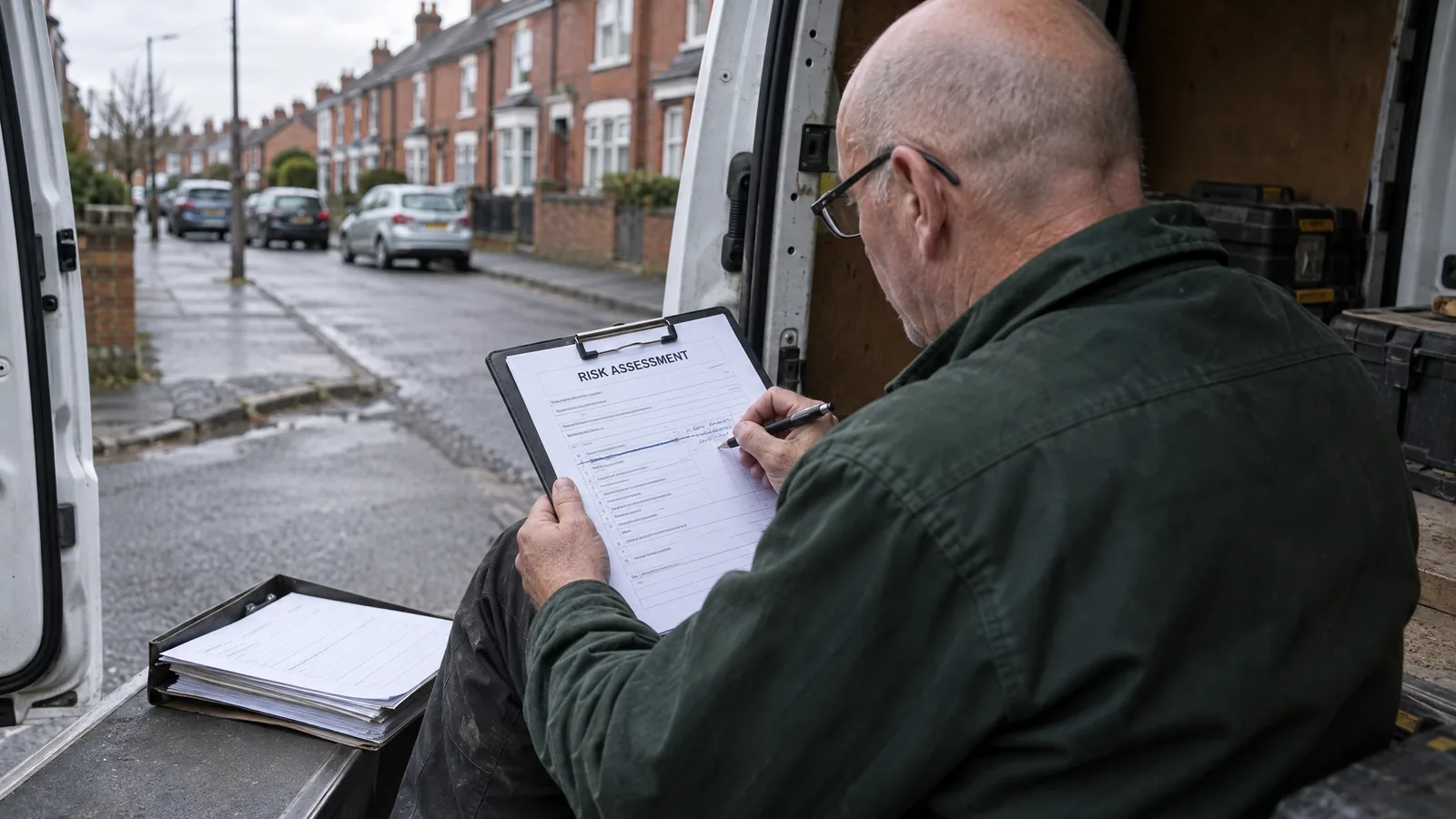
What the law asks for
In Great Britain, the duty comes from regulation 3 of the Management of Health and Safety at Work Regulations 1999 (MHSWR). Employers must make a "suitable and sufficient" assessment of the risks to their employees and to anyone else affected by their work. Self-employed people have a similar duty where their work could put other people at risk, and HSE lists construction among the activities where the law applies to them.
Three points matter if you use a template:
- The format is up to you. Regulation 3 does not prescribe a form, so a template is a legitimate way to keep the record.
- A written record is required with five or more employees. You must then record the significant findings and any group of employees identified as especially at risk (regulation 3(6)). With fewer, including none if you work alone, the general risk assessment rules do not require one, though other duties can require paperwork, such as a construction phase plan if you are the only contractor on construction work. Writing it down is still sensible, and clients and principal contractors often ask to see it.
- The assessment must be reviewed when things change. Regulation 3(3) requires a review when there is reason to suspect the assessment is no longer valid, or after a significant change. The regulation sets no fixed review period.
HSE's guidance on managing risk also warns against relying purely on paperwork: your main priority is to control the risks in practice. The assessment is the thinking. The template is only where you write it down.
When a risk assessment template is good enough
HSE offers a free risk assessment template and examples. The template is a simple record of who might be harmed and how, what you are already doing to control the risks, what further action is needed, who will take it and by when. The examples, for businesses such as an office, a local shop, a motor vehicle repair shop and a warehouse, are there to help you think about hazards and controls.
The same page carries a warning: do not "just copy an example and put your company name to it". HSE says that would not satisfy the law and would not protect your employees, and that you must think about the specific hazards and controls your business needs.
So a template is a good starting point when it is either:
- a blank structure, such as headings or columns to fill in, rather than someone else's answers; or
- your own earlier assessment for the same task, on the same kind of site, with the same people, equipment and substances.
Either way, check it against this job before you rely on it, because a template stops working when it is used as the assessment itself. A generic risk assessment is written to cover broad scenarios, so it cannot know this site. Work at height on one job has different access, weather exposure and ground conditions from the last. The products in the van change from job to job. The risky version is the familiar one: copy, paste, change the date.
How to adapt a risk assessment template: a six-step check before work starts
Run through this with the template open and the job in front of you, on site if you can. HSE's first step in managing risk is to look around the workplace and think about what may cause harm, so start with the job, not the template.
- Delete what does not apply. Hazards and controls carried over from another job bury the ones that matter and suggest the document was not checked for this one. Lines about ladders and roof edges have no place in an assessment for work at ground level.
- Add what is new on this site. Think about access and height, ground conditions, weather, other trades, the public or occupants, services in walls or ground, and non-routine work such as cleaning or maintenance. Think too about people HSE says may need particular care, such as young workers, new or expectant mothers and people with disabilities. If others will do the work, ask them: HSE notes they will usually have good ideas.
- Write controls you will actually use. HSE expects you to do what is "reasonably practicable", balancing the level of risk against the money, time or trouble of controlling it. Cross out any control you will not use and write down what you will do.
- Name the people. Record who might be harmed and how, who will carry out each action and by when, and who made the assessment. A signature alone does not show that anyone thought about this job, so put the names and details in the body.
- Date it and set a review trigger. Write down what would make you look at it again: a change of site, method, people, equipment or substances, an accident or near miss, or anything that suggests it no longer fits. Update the record whenever you change it.
- Move substances into a COSHH assessment. A line about "chemicals" is not enough. If a product label warns of a health hazard, or the work makes dust or fumes, assess it in a COSHH assessment, which goes substance by substance. Asbestos and lead are the exceptions: they have their own regulations, which apply instead of COSHH. If you suspect asbestos, stop and get it checked before anyone drills or cuts: HSE says it may be in any building built or refurbished before 2000.
If the check leaves little of the original wording, the template has still done its job by giving you the structure.
If a client also wants a method statement, treat its template the same way: keep the structure and fill it in for this job. Our guide to writing a method statement has a free template with ten sections. On a small job you may not need one by law: see do I need a method statement for a small job?
HSE prosecutions and notices in 2024/25
HSE's annual report for 2024/25 gives the scale of enforcement: over 4,400 notices issued, 246 criminal prosecutions completed with a 96% conviction rate, and over £33 million in fines. Notices were far more common than prosecutions. The report says prosecutions were brought in cases involving a serious breach of the law.
Two points about how it works:
- HSE does not fine anyone. Fines are imposed by the courts after a prosecution, and HSE states that it does not pass sentences or collect any fines imposed.
- HSE does charge for its time. If an inspector finds a material breach, one serious enough that they formally write to you requiring action, HSE charges a fee for intervention of £188 an hour for the time it takes to identify what is wrong and help put it right.
Nothing in these figures says how many cases involved a template, so they are not a verdict on templates either way. Whatever you start from, the duty is the same: an assessment that matches this job, and controls that are actually in place.
If you would rather not start from a template
AI RAMS is our own tool, so weigh this section with that in mind. Instead of filling in a template, you describe the job in a chat and answer its follow-up questions, and the tool drafts a risk assessment. You check the draft in a watermarked preview, edit it, then download it as a PDF or Word file.
Creating, previewing and editing are free, with no card needed to start. To download, you pay once per document, which unlocks its downloads, including after later edits, or take Pro for unlimited downloads. Each document has its own chat, so a method statement or a COSHH assessment is a separate conversation.
A tool cannot see your site either. Check its draft against the job as you would a template, then run the extra checks an AI draft needs, such as looking for details you never gave it. Our guide to checking an AI-drafted risk assessment sets them out, and our guide to choosing between a template, an AI tool and a consultant compares the options. You remain responsible for what you sign, and a template you have checked against the job is just as good a starting point.
Before you use a template on the next job
Risk assessment templates are not dead. Use one for its structure, never as a substitute for looking at the job. Before work starts, delete what does not apply, add what is new, write down the controls you will actually use, name the people, date it with a review trigger, and put hazardous substances in a COSHH assessment. If you suspect asbestos, stop and get it checked first.
Frequently asked questions
Is a risk assessment template good enough?
As a starting point, yes. The law on risk assessment does not prescribe a form, so a template is a legitimate way to record your assessment, and HSE publishes a free one. It is not enough on its own: HSE warns that copying an example and putting your company name to it would not satisfy the law. Check it against the job and adapt it before work starts.
Can I use HSE's risk assessment template?
Yes. HSE's free template is a simple record of who might be harmed and how, what you are already doing to control the risks, what further action is needed, who will take it and by when. Its examples are there to help you think about hazards and controls. HSE says you must still think about the specific hazards and controls your business needs, so fill it in for your own work.
Is a generic risk assessment acceptable?
Not on its own. A generic risk assessment is written to cover broad scenarios, so it cannot know your site, the people there or the equipment and substances on this job. Use it for its structure, then delete what does not apply, add what is new and write down the controls you will actually use before work starts.
Can I reuse a risk assessment from a previous job?
Yes, if it is your own earlier assessment for the same task, on the same kind of site, with the same people, equipment and substances. Check it against this job before you rely on it: delete what does not apply, add what is new, name the people, date it and set a new review trigger.
Do I need a written risk assessment with fewer than five employees?
You must still make the assessment, but the general risk assessment rules only require a written record of the significant findings once you have five or more employees. With fewer, writing it down is still sensible, and clients and principal contractors often ask to see it. Other duties can require paperwork, such as a construction phase plan if you are the only contractor on construction work.
How often should a risk assessment be reviewed?
The general risk assessment rules set no fixed period. Regulation 3(3) of the Management of Health and Safety at Work Regulations 1999 requires a review when there is reason to suspect the assessment is no longer valid, or after a significant change. Write down what would trigger one on your job, such as a change of site, method, people, equipment or substances, or an accident or near miss.
By Filip Perkon, Director, AI RAMS. Legal points last checked on 5 October 2026 against HSE guidance and legislation.gov.uk. This is general information, not legal advice.
Ready to try AI-powered RAMS?
Create, preview and edit documents free, with no card needed. Pay only when you download.
Start free