
Do I Need a Method Statement for a Small Job?
In Great Britain, the law does not usually require a method statement for a small job, at least not by that name. It does expect you to assess the risks. If you are the only contractor on construction work, even a small domestic job, it also expects a written construction phase plan. Demolition, dismantling and work with asbestos need their own written plan. Clients often ask for a method statement too, so keep yours short and specific.
A client, letting agent or principal contractor has asked whether you have RAMS: a risk assessment (hazards and controls) and a method statement (the safe order of work). Or you are unsure whether you need a method statement for a small job you are about to start.
This page covers what the law says, a 30-second check for your own job, and a one-page method statement for a basin swap. For a longer document, see how to write a full method statement.
What the law says about a method statement for a small job
Risk assessment
The Management of Health and Safety at Work Regulations 1999 (MHSWR) require a suitable and sufficient risk assessment. Regulation 3 extends that to self-employed people whose work could put other people at risk. HSE lists construction among the high-risk activities where the law applies to you.
Under the general risk assessment rules, you only have to record the findings if you employ five or more people (regulation 3(6)). Writing them down is still sensible.
Construction phase plan
The Construction (Design and Management) Regulations 2015 (CDM 2015) add a second duty. If you are the only contractor on a project, you must draw up a construction phase plan, or have one drawn up, before setting up the site (regulation 15(5)).
HSE's sheet CIS80 says a plan is required for every construction project and does not need to be complicated. For a domestic client, it says you are in control of the project if you are the only contractor.
Written-plan duties, and what HSE says about method statements
Two rules in law require a written plan without using the words "method statement". CDM 2015 regulation 20 says the arrangements for demolition or dismantling must be recorded in writing before the work begins.
Regulation 7 of the Control of Asbestos Regulations 2012 says an employer must not do work with asbestos without a suitable written plan of work. Its regulation 3 applies the Regulations to self-employed people too.
HSE's administration page lists structural alteration with demolition and dismantling, and says the arrangements for all three must be written down, usually as a method statement. CIS80's example of structural alteration is removing a chimney breast.
For other construction work, HSE says a method statement is not required by law but is an effective, practical way to plan, manage and monitor the work.
When someone else asks for one
Beyond those duties, clients and principal contractors often make a method statement a condition of starting work, through a contract term or site rule. Where there is a principal contractor, CDM 2015 regulation 15(3) also makes following their directions a legal duty.
Before you write anything, ask back three things:
- What format do they want? Their form, a template or your own page.
- Who has to sign it?
- When do they need it?
If they only want to know how you will work safely, one page is a fair reply. If a principal contractor wants more, the full ten-section version is the safer starting point.
The 30-second check
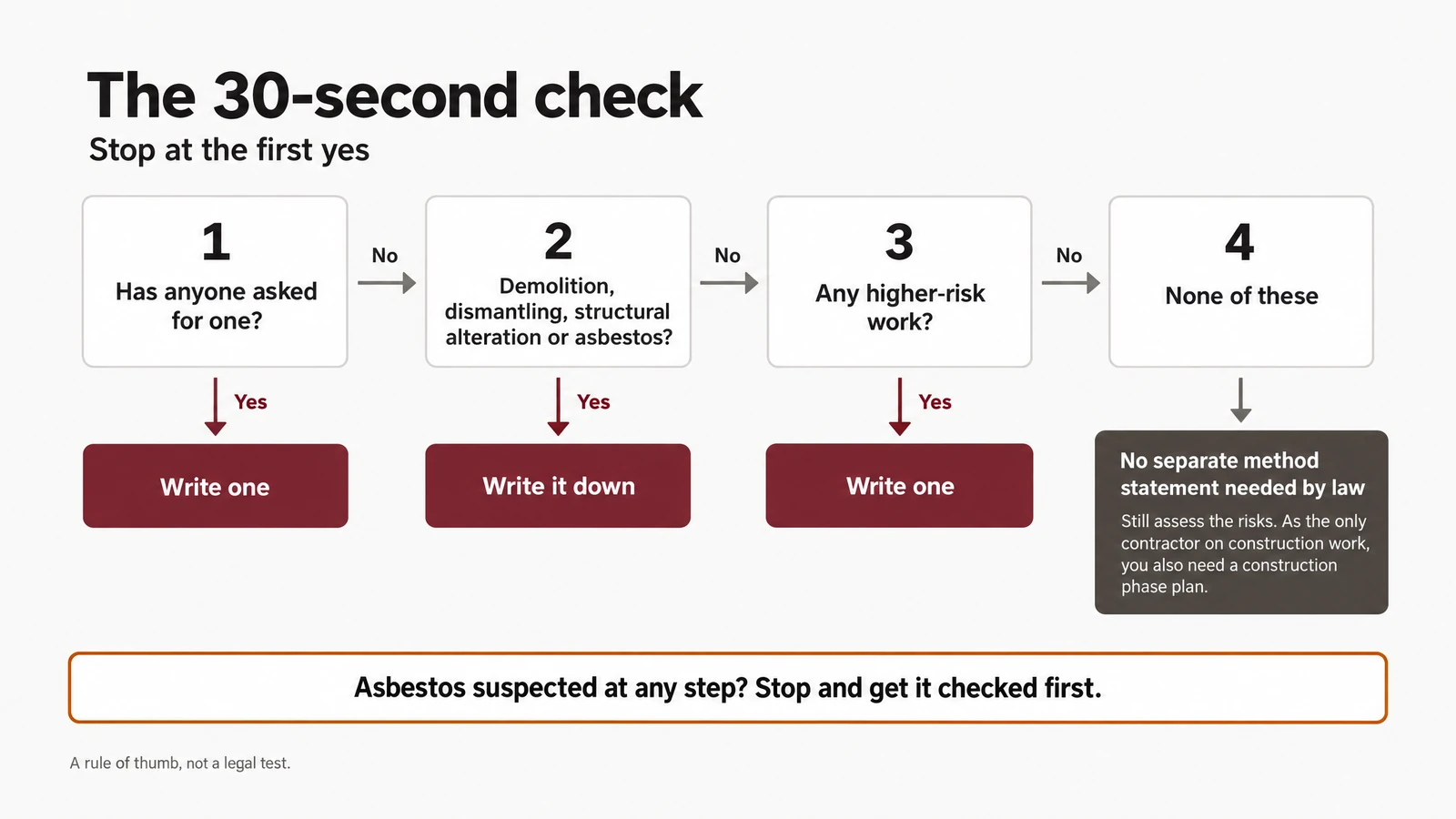
Run these in order and stop at the first yes. Whichever step you stop at, settle the asbestos question first.
- Has anyone asked for one? A client, a principal contractor, or your contract or tender. Yes: write one. It is a condition of the job, whatever the law says. Stop here.
- Is any of it demolition, dismantling, structural alteration or work with asbestos? HSE says asbestos may be in any domestic or commercial building built or refurbished before 2000. If you suspect it, stop, do not drill or cut, and get it checked first. Asbestos work also needs the right training, and work on asbestos lagging, sprayed coatings and most asbestos insulating board needs a licensed contractor. Yes: write it down, in method statement format. The law requires a written plan for all but structural alteration, which HSE's guidance adds.
- Any higher-risk flag? Work at height, including roof, scaffold or tower work; lifting equipment such as cranes or hoists; hot work; confined spaces; excavation or digging near services; live electrical work; dust or hazardous substances you cannot control at the source; other trades around you; or vulnerable people in the work area. Yes: write one.
- None of the above? No separate method statement is required by law. You still need to assess the risks. If you are the only contractor on construction work, you also need a short written construction phase plan.
This check is a rule of thumb, not a legal test. HSE's pages on roof work and lifting operations refer to a method statement; the other flags in step 3 are our own.
Whichever step you stop at, the risk assessment and, for the only contractor on construction work, the construction phase plan still apply.
Walking a basin swap through the check
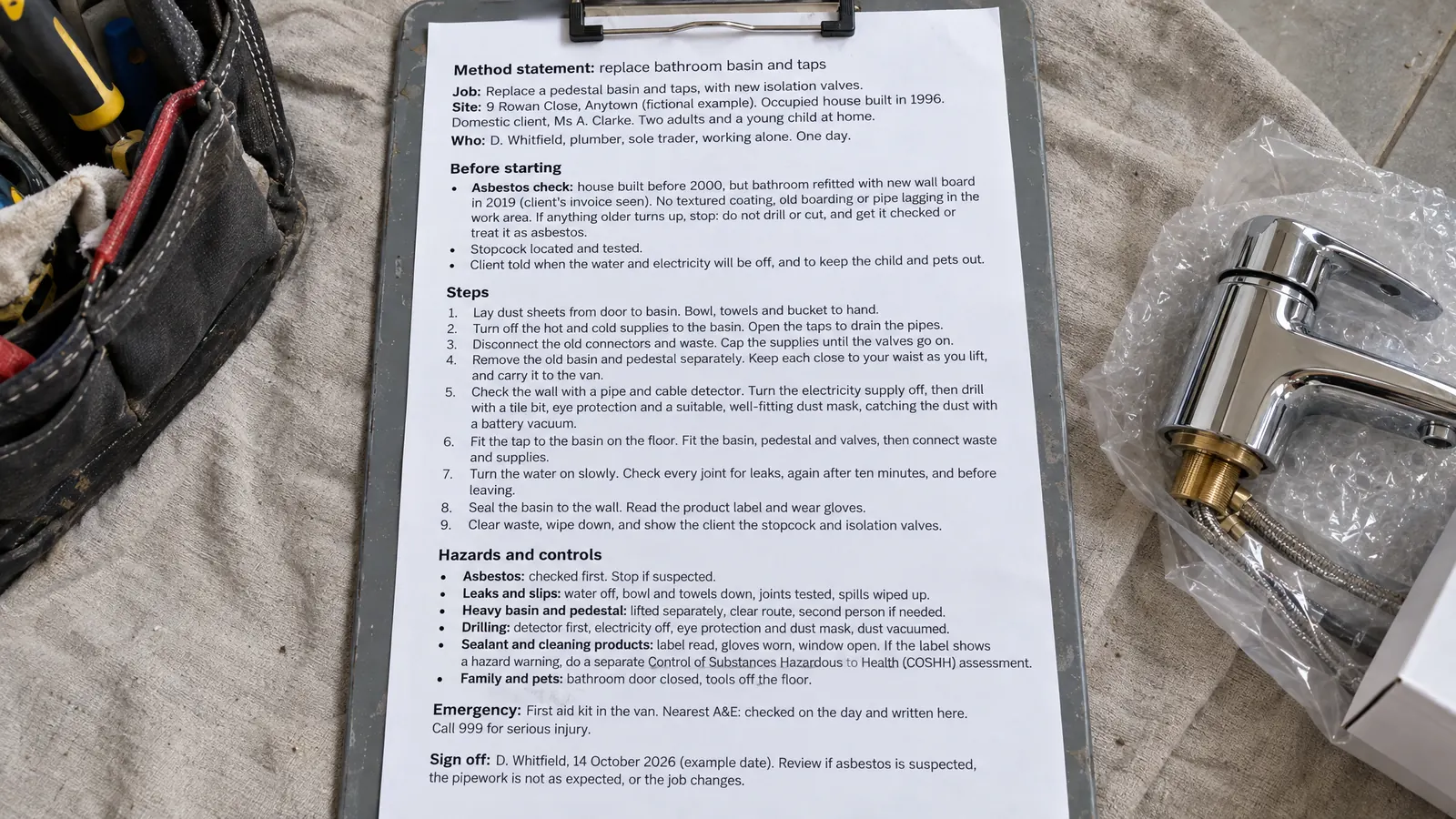
The fictional basin swap note from this section, printed for the job.
Take a plumber replacing a bathroom basin and taps in an owner-occupied house built in 1996, with a young child at home. Nobody has asked (step 1).
Nothing is demolished, dismantled or structurally altered. The house predates 2000, so the asbestos check comes first. The client's invoice shows a 2019 refit with new wall board, and the work area has no textured coating, old boarding or pipe lagging. Step 2 is a no unless something older turns up.
Step 3 is a no: the child is kept out of the work area, drilling dust is vacuumed at the source, the sealant is used as its label directs with the window open, and the basin is lifted by hand, with no lifting equipment. That leaves step 4: no method statement required by law.
It is still construction work, and as the only contractor, the plumber needs a construction phase plan. Regulation 2(1)(a) of CDM 2015 covers fitting out, renovation, repair and maintenance of a structure, and CIS80 names a plumber installing a bathroom. If your own job is borderline, read the definition first.
The plumber still writes the one-page note below, to start that plan and keep a dated record. It is fictional, with a made-up address, client and date.
Method statement: replace bathroom basin and taps
Job: Replace a pedestal basin and taps, with new isolation valves.
Site: 9 Rowan Close, Anytown (fictional example). Occupied house built in 1996. Domestic client, Ms A. Clarke. Two adults and a young child at home.
Who: D. Whitfield, plumber, sole trader, working alone. One day.
Before starting
- Asbestos check: house built before 2000, but bathroom refitted with new wall board in 2019 (client's invoice seen). No textured coating, old boarding or pipe lagging in the work area. If anything older turns up, stop: do not drill or cut, and get it checked or treat it as asbestos.
- Stopcock located and tested.
- Client told when the water and electricity will be off, and to keep the child and pets out.
Steps
- Lay dust sheets from door to basin. Bowl, towels and bucket to hand.
- Turn off the hot and cold supplies to the basin. Open the taps to drain the pipes.
- Disconnect the old connectors and waste. Cap the supplies until the valves go on.
- Remove the old basin and pedestal separately. Keep each close to your waist as you lift, and carry it to the van.
- Check the wall with a pipe and cable detector. Turn the electricity supply off, then drill with a tile bit, eye protection and a suitable, well-fitting dust mask, catching the dust with a battery vacuum.
- Fit the tap to the basin on the floor. Fit the basin, pedestal and valves, then connect waste and supplies.
- Turn the water on slowly. Check every joint for leaks, again after ten minutes, and before leaving.
- Seal the basin to the wall. Read the product label and wear gloves.
- Clear waste, wipe down, and show the client the stopcock and isolation valves.
Hazards and controls
- Asbestos: checked first. Stop if suspected.
- Leaks and slips: water off, bowl and towels down, joints tested, spills wiped up.
- Heavy basin and pedestal: lifted separately, clear route, second person if needed.
- Drilling: detector first, electricity off, eye protection and dust mask, dust vacuumed.
- Sealant and cleaning products: label read, gloves worn, window open. If the label warns of a health hazard, do a separate Control of Substances Hazardous to Health (COSHH) assessment.
- Family and pets: bathroom door closed, tools off the floor.
Emergency: First aid kit in the van. Nearest A&E: checked on the day and written here. Call 999 for serious injury.
Sign off: D. Whitfield, 14 October 2026 (example date). Review if asbestos is suspected, the pipework is not as expected, or the job changes.
The note covers much of the same ground as CIS80 but leaves out key dates and welfare facilities (toilet, washing and rest). Add those and check the result against the blank plan in CIS80.
A one-page version suits a small domestic job. A principal contractor on a managed site may want plant and equipment, materials and personal protective equipment (PPE) as their own sections. Then the full ten-section version is the one to use.
What happens if you skip it
- In practice: you may be turned away, delayed or lose the job.
- Legally: outside the written-plan duties covered earlier, lacking a document called a method statement is not by itself a breach, unless a principal contractor's directions or construction phase plan require one. The exposure sits in the duties underneath: risk assessment, planning the work and the construction phase plan. HSE can issue improvement and prohibition notices, and prosecute in some cases.
- If something goes wrong: you will want to show how you assessed the risks and planned the work. A dated one-page note is the simplest record of that.
- Insurance: read your policy wording and ask your broker what they expect.
The least you should do on a tiny job
For work that reaches step 4, our suggested minimum is:
- Think through the risks and note three to five lines on your phone.
- If the building was built or refurbished before 2000, settle the asbestos question before you start.
- If it is construction work and you are the only contractor, write a short construction phase plan, using CIS80 as the template.
- Keep your notes, the plan and a couple of dated photos.
If you would rather not type your risk notes on your phone, AI RAMS can draft a risk assessment or a method statement from a description of the job and your answers to its follow-up questions. It does not make construction phase plans. You check the draft against the real job and edit it before it goes anywhere.
Frequently asked questions
Do I need a method statement for a small job?
Usually not by law in Great Britain, at least not by that name. You do need to assess the risks and, if you are the only contractor on construction work, draw up a construction phase plan. Demolition, dismantling and work with asbestos need a written plan, and HSE's guidance adds structural alteration, such as removing a chimney breast. Clients often ask for a method statement too, so a short one is sensible.
Are method statements a legal requirement in the UK?
Not as a general rule. In Great Britain, the law requires a written plan for demolition, dismantling and asbestos work, and HSE's guidance adds structural alteration. For other construction work, HSE says method statements are not required by law but are an effective way to plan and manage the work.
Does a sole trader need a risk assessment?
Yes, if your work could put other people at risk, which includes construction work. Under the general risk assessment rules, you only have to record the findings if you employ five or more people, but writing them down is sensible.
What is a construction phase plan, and do I need one for a small domestic job?
It is a written plan of the health and safety arrangements for a construction job, drawn up before work starts. If you are the only contractor, including on a domestic job, getting it drawn up is your job. HSE says the effort should match the project's complexity and risks, and CIS80 has a blank template.
What happens if I do not have a method statement?
You may be turned away. In law, lacking one is not by itself a breach, except where the law needs a written plan (demolition, dismantling or asbestos work) or a principal contractor's directions or construction phase plan require one. HSE's guidance adds structural alteration. The legal risk sits in the duties underneath: assessing the risks, planning the work and, as the only contractor on construction work, having a construction phase plan. If those are missing, HSE can issue notices and prosecute in some cases.
Do I need a method statement as a subcontractor on someone else's site?
Often, yes: principal contractors commonly require one before you start. CDM 2015 does not mention method statements, but on a project with more than one contractor it requires you to follow the principal contractor's directions and the relevant parts of their construction phase plan. So their requirement for one is likely to count as one of those directions. Ask what format they want and keep it short and specific.
How long should a method statement for a small job be?
There is no legal length. One page is our advice for a small domestic job, like the basin swap. A bigger job, a multi-trade site or a principal contractor's template may need more.
By Filip Perkon, Director, AI RAMS. Legal points last checked on 2 October 2026 against HSE guidance and legislation.gov.uk. This is general information, not legal advice.
Ready to try AI-powered RAMS?
Create, preview and edit documents free, with no card needed. Pay only when you download.
Start free