
How to Write a COSHH Assessment (UK): Guide with Example

Most trades use hazardous substances every working day without thinking of them that way. Solvent-based paints, expanding foam, fuel, cement, the dust that comes off a cut, the chemicals in the van for cleaning up. If someone on your job works with any of them, the law expects a COSHH assessment before the work starts, and a principal contractor or client may ask to see it.
This guide covers what a COSHH assessment actually is, which substances need one and which do not, what the warning symbols mean, and a step-by-step method for writing an assessment that stands up to inspection. There's a full worked example for a common trade job, a copy-paste template, and answers to the questions people actually search for.
What Is a COSHH Assessment?
COSHH stands for the Control of Substances Hazardous to Health Regulations 2002. A COSHH assessment is the written record of how you looked at each hazardous substance used on a job, worked out who could be exposed to it and how, and decided on the controls that keep that exposure adequately controlled.
In plain terms it answers four questions. What are you using or creating? What harm can it do? Who could breathe it in, get it on their skin, or swallow it? And what are you doing about it, in the order the law prefers: getting rid of the substance, swapping it for something safer, controlling it at source, and only then relying on protective equipment.
Is a COSHH Assessment a Legal Requirement?
Yes. Regulation 6 of COSHH 2002 says an employer must not carry out work liable to expose employees to a substance hazardous to health until a suitable and sufficient assessment has been made. If you have five or more employees, the significant findings must be recorded in writing. Sole traders and smaller firms still have the duty to assess, and in practice a written assessment is what a client or principal contractor will want to see if they ask.
COSHH Assessment vs Risk Assessment: What's the Difference?
A COSHH assessment is a risk assessment, but a specialised one. A general risk assessment covers all the hazards of a job: falls, manual handling, electricity, moving plant. A COSHH assessment goes substance by substance, and records things a general assessment never captures, like hazard classifications from the product label, workplace exposure limits, exposure routes, and health surveillance. On most jobs you need both, and they are usually bundled with the method statement as part of your RAMS pack. If you're writing that too, our method statement guide covers it section by section.
Which Substances Need a COSHH Assessment?
Anything used at work that can harm health, whether you bought it in a container or the work itself creates it. The second kind is the one that gets missed.
- Solvents and paints: solvent-based paints, primers, thinners, adhesives and expanding foams. Flammable vapours and irritation are the usual hazards, and two-pack products can contain isocyanates, which are a serious respiratory sensitiser.
- Fuels: petrol and diesel handled on site, for generators, saws and plant.
- Cement and mortar: wet cement burns skin, and the dust irritates the lungs.
- Dusts created by the work: silica dust from cutting concrete, brick or stone, and wood dust from sawing and sanding. Both have workplace exposure limits and both are assessed under COSHH even though nobody bought them in a tin.
- Welding fume: classified as carcinogenic, and firmly a COSHH matter.
- Cleaning products: degreasers, drain cleaners, bleach and site cleaning chemicals. Ordinary domestic products used occasionally may not need a formal assessment, but products used regularly as part of the work do.
Worth knowing at tender stage: asbestos and lead are not covered by COSHH. They have their own regulations, the Control of Asbestos Regulations 2012 and the Control of Lead at Work Regulations 2002, with their own stricter requirements. A COSHH form is not the right paperwork for either, and reviewers notice.
COSHH Symbols and What They Mean
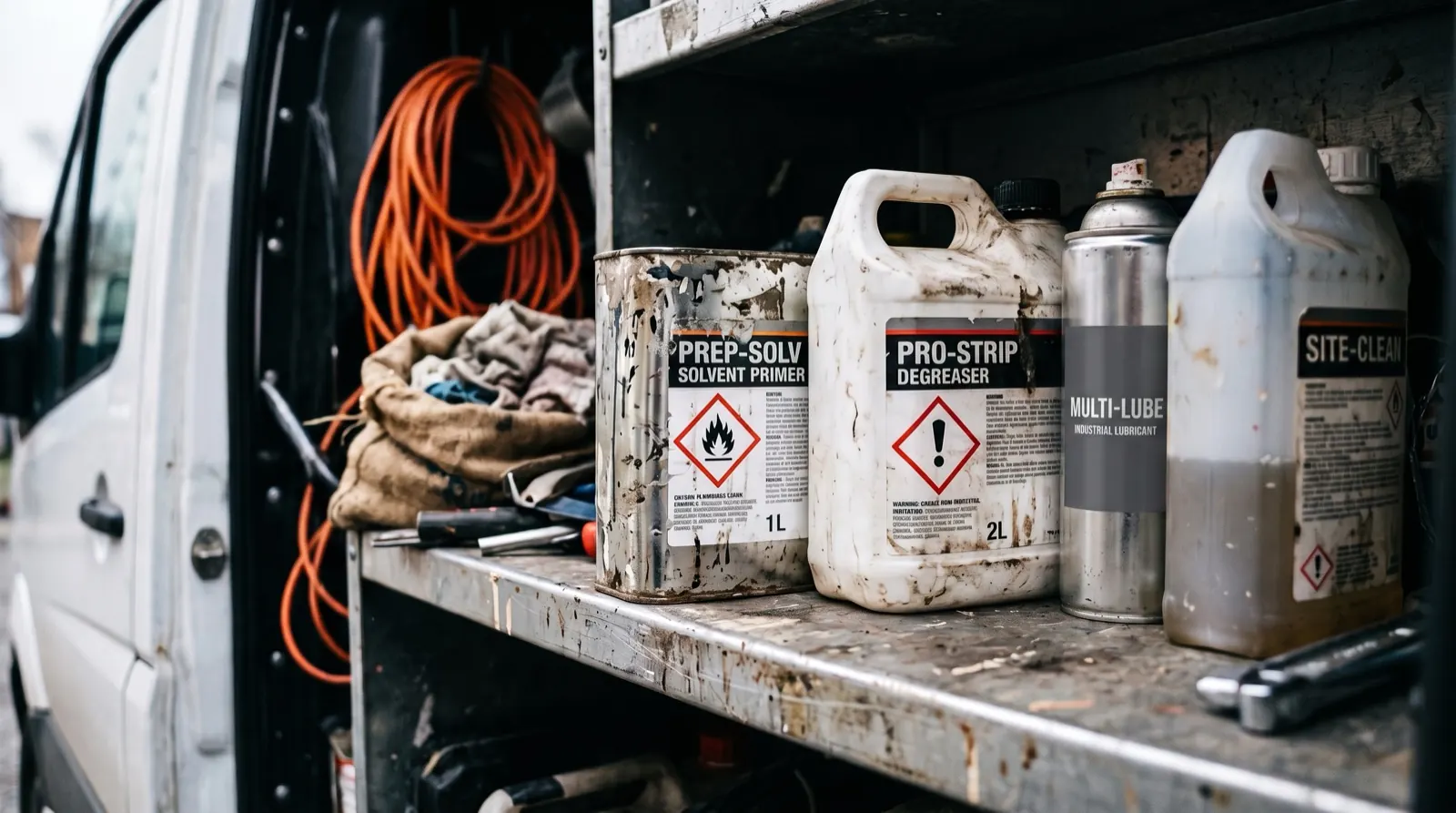
The red-bordered diamonds on a product label are GHS hazard pictograms, and they are the starting point of every COSHH assessment. There are nine:
- Flame: flammable liquids, gases or aerosols. Common on solvents and adhesives.
- Exclamation mark: irritant to skin, eyes or airways, or harmful if swallowed. The most common symbol on trade products.
- Health hazard (the silhouette with a starburst chest): serious longer-term effects such as respiratory sensitisation, carcinogenicity or organ damage. Take this one seriously wherever it appears.
- Corrosion: burns skin and eyes. Drain cleaners, some cements and acids.
- Skull and crossbones: acutely toxic, can be fatal at low doses.
- Gas cylinder: gas under pressure.
- Flame over circle: oxidiser, makes fires fiercer.
- Exploding bomb: explosive.
- Dead tree and fish: hazardous to the environment, which matters for storage and disposal.
The pictograms tell you which hazards to assess. The detail behind them lives in the H-statements on the label and in the product's Safety Data Sheet, which the supplier must provide. Section 8 of the SDS lists the exposure limits and the protective equipment the manufacturer expects.
How to Do a COSHH Assessment: Step by Step
- List every hazardous substance on the job. Walk the job in your head from start to finish, including the substances the work creates: dust from cutting, fume from welding. This list becomes your substance register.
- Collect the label and SDS information for each. Note the product name exactly as it appears on the container, the pictograms, the H-statements, and anything in SDS section 8 about exposure limits. UK workplace exposure limits are published in HSE document EH40/2005.
- Work out who could be exposed and how. The person using the product, anyone else nearby, and the exposure routes: breathed in, on skin, in eyes, swallowed. Think about anyone at increased risk, such as young workers or anyone with asthma or a skin condition.
- Judge the level of exposure. How much is used, how often, for how long, and in what kind of space. Two litres of solvent a day indoors is a different assessment from an occasional touch-up outside.
- Decide the controls, in the right order. The law wants prevention before protection: eliminate the substance if the job allows, substitute for something safer, control at source with ventilation or on-tool extraction, tighten the working method, and only then rely on PPE. Where respiratory protective equipment is needed, everyone wearing it needs a face-fit test.
- Cover storage, spillage, disposal and first aid per substance. Where it's kept, what happens if it spills, how waste leaves site, and what to do if someone is exposed. SDS sections 4, 6, 7 and 13 give you the raw material.
- Add the job-wide arrangements. Emergency procedures, any health surveillance the substances call for, and the information, instruction and training everyone gets before work starts. These are duties under COSHH regulations 11, 12 and 13, not optional extras.
- Record it, sign it, and set a review trigger. Name the person who did the assessment, date it, and state when it gets looked at again: when a product, method or site changes, or after an incident, and at a sensible interval regardless.
Worked Example: Solvent-Based Primer on a Kitchen Refit
A realistic example for a small job: a decorator applying solvent-based primer to woodwork on a domestic kitchen refit. Product names and classifications are illustrative, so always take the real ones from your own product's label and Safety Data Sheet.
Substance
Solvent-based wood primer, 2.5 litre tin, applied by brush. Label carries the flame and exclamation mark pictograms. Typical statements for this product family: highly flammable liquid and vapour, may cause drowsiness or dizziness, causes serious eye irritation. No workplace exposure limit for the product itself; the SDS lists limits for its solvent ingredients.
Who Might Be Exposed and How
One decorator applying the primer, by inhalation of vapour and skin contact. The householder and other trades could be exposed if they enter during application or before the room has aired.
Exposure Judgement
About half a litre used per day for two days, indoors. Windows and external door open throughout, giving good natural cross-ventilation. Exposure is short duration but in a domestic room, so vapour build-up is the main concern.
Controls, in Hierarchy Order
- Water-based primer considered first: ruled out on this job because the specification requires a solvent-based product over existing finishes.
- Windows and external door kept open for cross-ventilation during application and for one hour after.
- Room closed to the householder and other trades until aired, with a sign on the door.
- Tin kept closed when not decanting, brushes cleaned into a lidded container.
- Nitrile gloves and safety glasses during application and brush cleaning. No RPE needed at this quantity with the ventilation above, per the SDS.
Storage, Spillage, Disposal, First Aid
Stored in the van in the original tin, upright, away from ignition sources. Spills soaked up with rags or absorbent granules, bagged and removed, never into drains. Waste primer and contaminated rags to a licensed waste facility. Eye contact: rinse for at least 15 minutes and seek advice if irritation persists. Inhalation symptoms: fresh air and rest.
Sign Off and Review
Assessed by the decorator carrying out the work, dated, reviewed if the product or the ventilation situation changes, and before the next job that uses it.
Copy-Paste COSHH Assessment Template
One assessment per substance is the cleanest structure. Fill in every bracket from the actual label and SDS, not from memory.
COSHH ASSESSMENT

JOB AND ASSESSOR
Job/site: [address and brief description]
Assessed by: [name]            Date: [date]
Review trigger: [what would make you reassess, plus a backstop date]

1. SUBSTANCE
Product name (as on container): [name]
Supplier/manufacturer: [name]
Form: [liquid / gel / aerosol / dust / fume / vapour / solid]
Pictograms on label: [list]
Hazard statements (from label/SDS): [list]
Workplace exposure limit (EH40 / SDS section 8): [value or "none listed"]

2. EXPOSURE
Who might be exposed: [users, others nearby, anyone at increased risk]
Routes: [inhalation / skin / eyes / ingestion]
Quantity, frequency, duration: [how much, how often, how long]
Where used: [indoors/outdoors, ventilation, confined space]

3. CONTROLS (in this order)
Elimination or substitution considered: [outcome and why]
Engineering controls: [ventilation, extraction, enclosure]
Working method controls: [quantities, access, timing, hygiene]
PPE and RPE: [items, standards, face-fit where RPE is used]

4. STORAGE, SPILLAGE, DISPOSAL, FIRST AID
Storage: [where and how]
Spillage: [immediate actions]
Disposal: [route for waste and containers]
First aid: [per exposure route, from SDS section 4]

5. JOB-WIDE ARRANGEMENTS
Emergency arrangements: [fire, spill kit, eye wash locations]
Health surveillance: [needed or not, and why]
Information, instruction and training: [what is briefed and recorded]
Filling that in properly for every substance on a job takes real time, which is exactly what our COSHH assessment generator is for. Describe the job and the products, photograph a label if you have the tin in front of you, and it produces the full assessment, substance register, scoring and all, in minutes.
Common Mistakes That Undermine COSHH Assessments
- Assessing the job but not the substances. One line saying "COSHH: wear gloves" inside a general risk assessment is not a COSHH assessment.
- Copying hazard data from memory. Classifications differ between products that look interchangeable. Take them from the actual label and SDS every time.
- Ignoring the substances the work creates. Silica dust, wood dust and welding fume harm more people in the trades than anything bought in a container.
- Jumping straight to PPE. Reviewers look for evidence you considered elimination, substitution and ventilation first, because that is the legal order.
- RPE with no face-fit test. A mask that doesn't seal is paperwork, not protection, and face-fit records get asked for.
- Using a COSHH form for asbestos or lead. Both sit under their own regulations, and this mistake tells a reviewer the assessor doesn't know the boundary.
- No review trigger. An assessment with no plan for when it gets looked at again reads as a document written once to tick a box.
Frequently Asked Questions
What does COSHH stand for?
Control of Substances Hazardous to Health. The current regulations are the Control of Substances Hazardous to Health Regulations 2002, as amended, and they apply across the UK.
Is COSHH training a legal requirement?
Regulation 12 of COSHH 2002 requires employers to give anyone who may be exposed suitable information, instruction and training: what the substances are, what the risks are, how to use the controls, and what to do in an emergency. A formal certificate is not what the law names, but you must be able to show people were trained, so a recorded briefing is the practical minimum.
Do cleaning products need a COSHH assessment?
If cleaning chemicals are used as part of the work, regularly or in quantity, yes. The everyday exception is genuinely domestic-style use, a squirt of washing-up liquid in the site kitchen. Degreasers, drain cleaners, and anything with a hazard pictogram on the label that your team uses to do the job should be on the register.
Does COSHH cover asbestos, lead or silica dust?
Silica dust, yes, along with wood dust and welding fume. Asbestos and lead, no: they are covered by the Control of Asbestos Regulations 2012 and the Control of Lead at Work Regulations 2002 respectively, which have their own stricter assessment and licensing requirements.
How often should a COSHH assessment be reviewed?
Whenever there is reason to think it no longer applies: a new product, a different method, a different site, or after any incident or health complaint. On top of those triggers, set a backstop review date so no assessment runs on forever unread. Annually is a common and defensible choice for ongoing work.
Who can carry out a COSHH assessment?
Someone competent to do it, which means understanding the work, being able to read a label and an SDS, and knowing the hierarchy of control. For most trade jobs that is the tradesperson or supervisor who knows the job best, taking the hazard data from the supplier's documents rather than from memory.
How quickly can I put a COSHH assessment together?
By hand, it depends on how many substances the job uses and whether you have the safety data sheets to hand. With AI RAMS, our own tool, you describe the job and the products, attach a photo of the label if you have it, and get a draft substance-by-substance assessment with scoring, controls and the standing checks in minutes, ready for you to check and edit before you send it.
Get Your COSHH Assessment Done Before the Kettle's Boiled
A COSHH assessment that stands up is substance-specific, honest about exposure, and shows its working on controls. That takes longer to write than most people have the evening before a job. Try AI RAMS for free: describe the job and its products, and it drafts the COSHH assessment for you to check and edit. Creating, previewing and editing are free; you pay only when you download.
Ready to try AI-powered RAMS?
Create, preview and edit documents free, with no card needed. Pay only when you download.
Start free