
Electrical RAMS: What to Add for Isolation, Live Work and Testing
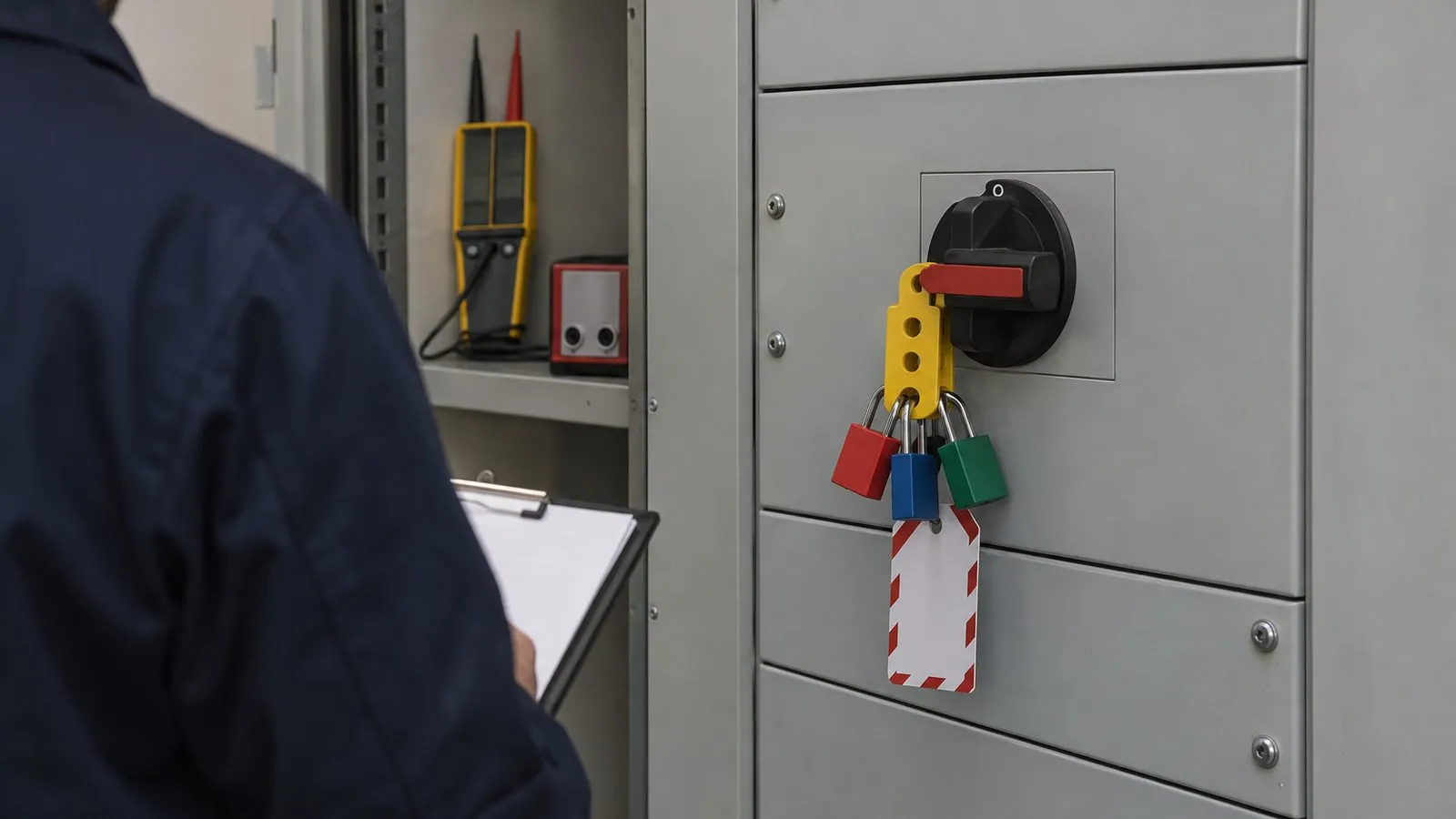
An electrical RAMS shows how the Electricity at Work Regulations 1989 apply to the job, and adds six things to a general one: isolation as numbered steps with named people, a reasoned decision on any live work, the site's permit and isolation rules, who else loses power, who is competent, and close-out testing and the certificate. In Great Britain, the law asks for a suitable and sufficient risk assessment, recorded if you employ five or more people. HSE says method statements are not required by law for most construction work, but a main contractor or client can make RAMS a condition of starting.
This page is for electricians and small electrical contractors asked for RAMS before low voltage work in a commercial or occupied building: new circuits, a rewire, or inspection and testing. It covers Great Britain, not high voltage or network operator work. Northern Ireland has its own regulations.
Small domestic job, and nobody has asked for paperwork? Run the 30-second check for small jobs first. Need a blank document? Our free RAMS template has both halves in Word and PDF.
What an electrical RAMS adds to a general one
Each of the six additions needs lines in both halves of an electrical risk assessment and method statement:
| Part | In the risk assessment | In the method statement |
|---|---|---|
| Safe isolation | Shock, burns or arcing from parts that may still be live | Numbered steps with named people |
| Live work, usually testing | Each live task, why it cannot be done dead, and its precautions | Where the supply goes back on, and who does the live tests |
| Site permit and isolation rules | Switching on while work is still going on | Who issues and clears the permit, and when |
| Power loss to others | Who and what loses power | The agreed shutdown time, and who tells the occupants |
| Competence | Who may isolate, test and supervise | A name against each of those steps |
| Close-out | Switching on before the work is checked | Testing, the certificate, and who gets a copy |
For the method statement's other sections, see how to write a method statement.
Safe isolation, written as method steps
Regulation 12 of the Electricity at Work Regulations 1989 requires suitable means, where necessary to prevent danger, for cutting off the supply and for isolation: separating the equipment "from every source of electrical energy", securely. Regulation 13 requires adequate precautions to prevent equipment made dead from becoming charged during the work.
HSE's safe working guidance, HSG85, recommends a dead-working sequence "as a guide". The first part of that sequence, written for a RAMS:
- Identify the circuit and every source that can feed it, such as solar PV, batteries or a generator. Never assume labelling is correct.
- Isolate at the agreed point, naming who isolates, holds the keys and may switch back on.
- Lock off with a safety lock that has a unique key, and keep the key. Where several people work on the same isolation, each fits their own lock to a multi-lock hasp.
- Fit a caution notice, with the responsible person's name and the date.
- Prove dead with a two-pole voltage indicator or test lamp that follows HSE guidance GS38, not a multimeter or a non-contact detector. Test the indicator on a proving unit, prove dead at the point of work, then test the indicator again. With three phases or more than one supply, HSG85 says to prove all supply conductors dead.
- Earth where necessary, and take precautions against adjacent live parts, such as circuits still on in a shared riser.
Treat every conductor as live until it is proved dead, as HSE's guidance on the Regulations, HSR25, advises.
HSR25 also says isolation procedures "should be formalised in written instructions or house rules"; the RAMS shows how yours apply on this job.
Live work: when the law allows it, and what to write
Regulation 14 sets three conditions for working on or near a live conductor where danger may arise:
- "it is unreasonable in all the circumstances for it to be dead; and"
- "it is reasonable in all the circumstances for him to be at work on or near it while it is live; and"
- "suitable precautions (including where necessary the provision of suitable protective equipment) are taken to prevent injury."
HSG85 adds: "If just one of these conditions cannot be met, live working must not be permitted and dead working is essential." GS38 adds: "Testing or fault finding on live systems or equipment is live working."
Client or programme pressure. HSR25 counts economic need as a factor to weigh against the risk, but HSG85 says minor inconveniences from working dead, "sometimes arising from commercial and time pressures, will very rarely outweigh the risks associated with live work". Agree a shutdown time instead.
Live testing does not automatically justify live repair. HSR25: "Although live testing may be justifiable it does not follow that there will necessarily be justification for subsequent repair work to be carried out live."
A permit never authorises live work, HSG85 says.
For each live task, write down:
- why it cannot be done dead
- who does it and who supervises
- the test equipment: insulated probes and fused leads that follow GS38
- temporary barriers with warning notices
- a second person, to avoid lone live working
- what happens if testing turns into fault finding
How it changes for installation, rewiring, and inspection and testing
| Job | What grows in the RAMS | Certificate or report |
|---|---|---|
| New circuits or alterations on a managed site | The site's permit and isolation rules; isolating at a supply point someone else controls | Installation or minor works certificate |
| Rewiring | Breaking into the fabric: asbestos register first, possibly a refurbishment survey; occupants without power | Installation certificate |
| Inspection and testing in an occupied building | Live testing, with the regulation 14 reasoning; a test turning into fault finding; circuits still in use | Condition report |
Site rules: permits, isolation and who else loses power
Electrical installation is construction work under the Construction (Design and Management) Regulations 2015 (CDM 2015). This page uses "main contractor" for CDM's principal contractor. With more than one contractor, regulation 15(3) requires you to follow its directions and the relevant parts of the construction phase plan. If the main contractor sets permit or isolation rules, write them in.
Permits. The Electricity at Work Regulations contain no permit requirement: a permit is the site's own system. HSG85 says low voltage permits are "not common practice" but "should be considered if their use would contribute to safety in specific circumstances". Where one is used, it should be issued only by a designated competent person, record the isolation points, locks, notices and work, and be returned for cancellation before anything is switched back on.
Who isolates. HSG85 says roles must be defined where contractors work on an occupier's system. HSE's testing guidance, INDG354, written mainly for equipment testing, says the person responsible for safe isolation "should be identified and agreed". Write that name into the RAMS.
Who else loses power. Ask the person who runs the building what the switch feeds: IT and servers, fire alarm, emergency lighting, refrigeration, access control, lifts, other tenants, and anyone relying on powered equipment. Agree the shutdown time with them, and who tells the occupants.
Competence: what the law asks and what the site asks
Regulation 16 requires the technical knowledge or experience needed to prevent danger, or appropriate supervision. HSR25 applies this to whoever isolates and lists what it includes, such as knowledge of electricity, experience of the work and understanding of the system. Supervision, it says, "does not necessarily require continual attendance at the work site". HSG85 adds that live working needs more supervision.
The regulation names no card, qualification or scheme, and nor does HSE's guidance on it. Competent person schemes are about self-certifying Building Regulations work. So write competence in two parts:
- For the law: a name against isolating, testing and supervising, with each person's relevant knowledge or experience, or who supervises them.
- For the site: any cards, qualifications or scheme membership the main contractor or client asks for, listed as their requirement.
Other hazards that come with electrical work
Asbestos comes first. HSE says it "may be part of any commercial or domestic building which was built or refurbished before the year 2000". In such a building:
- Ask for the asbestos register and check it covers where you will work. In non-domestic premises, the Control of Asbestos Regulations 2012 require the dutyholder to make sure that information reaches anyone liable to disturb asbestos.
- If you are breaking into the fabric, HSE says a refurbishment survey may be required. Its survey guide, HSG264, names ceiling voids and risers among the areas to survey.
- Older switchgear can contain asbestos parts: HSE's Asbestos essentials has a task sheet on arc shields.
- If you find suspect material, stop, keep people away and get it checked.
Then add a line each for work at height in ceiling voids and risers, hidden services when drilling, dust from chasing (see our guide to a COSHH assessment), manual handling of cable drums and boards, and fire.
Close-out: testing, certificates and notification
Inspect and test before use. BS 7671:2018+A4:2026, the current edition according to the IET, sets the procedures. Approved Document P, the guidance for homes in England, points to them, and its Welsh edition says installations should be inspected and tested "before they are taken into service". Write down when testing happens, which tests need the supply on, and who does them.
Name the certificate. From the IET's model forms:
- Electrical Installation Certificate: a new installation, new circuits, or a replacement consumer unit or distribution board. It is valid only with its schedules of inspections, circuit details and test results.
- Minor Electrical Installation Works Certificate: an addition or alteration to an existing circuit with no new circuit.
- Electrical Installation Condition Report: the condition of an existing installation, as at a periodic inspection.
Hand over. On CDM projects, the IET's model Electrical Installation Certificate says a copy goes into the project's health and safety documentation, so name who receives it.
Notification in dwellings. In England, notifiable work in a dwelling is a new circuit, a replacement consumer unit, or an addition or alteration to circuits in a special location (regulation 12(6A)). Through a competent person scheme, building control is told within 30 days of finishing (regulation 20); otherwise, before work starts, appoint a third-party certifier or tell building control. More is notifiable in Wales, also within 30 days. Scotland uses building warrants and approved certifiers. Where notification applies, name who notifies and how.
Commercial buildings. In a building with no homes and no supply from one, Part P does not apply, but other parts of the Building Regulations can: in England and Wales, some new fixed lighting in non-domestic buildings still needs notifying. Ask the main contractor or client whether building control covers your part.
Worked example (fictional): new circuits and a board change on an office fit-out
This made-up example shows the level of detail; the building, people and scores are fictional.
- Job: replace the second-floor distribution board and install new lighting and small power circuits.
- Building: a 1980s three-storey office block let to several tenants. The second floor is empty; the others stay occupied.
- Site: the main contractor runs the fit-out, with other trades on the floor and in the ceiling void. The facilities manager controls the riser switch feeding the board, under the building's permit system.
- Team: an experienced supervisor isolates, proves dead, tests and certifies, with an electrician under their direction.
Scores are likelihood x severity, banded as on our free RAMS template: 1 to 4 low, 5 to 9 medium, 10 to 16 high, 17 to 25 critical.
| # | Hazard (who) | Initial | Controls | Residual |
|---|---|---|---|---|
| 1 | Shock, burns or arcing at the board (both electricians) | 3 x 5 = 15 High | Confirmed nothing else feeds the board (no generator, solar PV or batteries); riser switch isolated under the permit system; own locks on a multi-lock hasp; caution notice; proved dead, indicator checked before and after | 1 x 5 = 5 Medium |
| 2 | Shock or burns during live tests, or a test turning into fault finding (supervisor, others nearby) | 3 x 5 = 15 High | Only tests that cannot be done dead, reason recorded; supervisor only; GS38 probes and leads; barrier, notice and second person; isolate, lock off and prove dead before any repair | 1 x 5 = 5 Medium |
| 3 | Switching on while someone is still working (electricians, other trades) | 2 x 5 = 10 High | Permit cancelled before switching on; each person removes only their own lock; trades confirmed clear; new circuits labelled | 1 x 5 = 5 Medium |
| 4 | Asbestos disturbed in the ceiling void, riser or old board (electricians, trades, occupants) | 3 x 5 = 15 High | Register checked for the floor, void and riser; refurbishment survey where the fabric is broken into; suspect material: stop, get it checked | 1 x 5 = 5 Medium |
| 5 | Power lost beyond the work area: shared lighting, fire alarm, access control, tenants (occupants) | 3 x 3 = 9 Medium | Facilities manager confirms what the switch feeds, agrees the time, tells tenants and arranges fire alarm and emergency lighting cover; task lighting | 1 x 3 = 3 Low |
| 6 | Falls from stepladders or podium steps (electricians) | 3 x 4 = 12 High | Only access equipment the site rules allow, checked before use; nobody works above another person | 1 x 4 = 4 Low |
Method steps, with any risk lines they answer:
- Before the day. The supervisor gets the asbestos register and permit arrangements, confirms what the switch feeds and that nothing else feeds the board, and agrees the shutdown and when trades will be clear. (Risks 1, 4, 5)
- Isolate and lock off. The supervisor isolates at the riser switch; each electrician fits their own lock and keeps the key; the supervisor fits a caution notice. (Risks 1, 5)
- Prove dead. Before anyone starts, the supervisor tests the indicator on the proving unit, proves all supply conductors dead at the board, then tests the indicator again, and decides whether earths or precautions against adjacent live parts are needed; the permit issuer (the building's designated competent person) then issues the permit, recording the work, the isolation point, locks and notices. (Risk 1)
- Install. The electricians remove the old board once the register or survey covers it, and run new circuits from permitted access equipment, drilling with dust control. (Risks 4, 6)
- Dead tests. The supervisor does the inspection and dead tests, recording results for the certificate's schedules.
- Clear the permit. The main contractor confirms nobody is on the new circuits, each electrician removes their own lock, and the issuer cancels the returned permit. (Risk 3)
- Switch on and test live. The issuer switches on; the supervisor does only the tests that need the supply on. Any fault: isolate, lock off and prove dead again before repair. (Risks 2, 3)
- Certificate and handover. Electrical Installation Certificate with its schedules, copied to the main contractor, who confirms whether building control covers any of it.
Electrical checks before you send it
- Every isolation point and other source of supply is named, with who isolates, holds the keys and switches back on, and each person's knowledge or experience, or their supervisor.
- The proving-dead steps are in order, with a two-pole voltage indicator and a proving unit.
- Each live test says why it cannot be done dead, who does it and who supervises, its precautions and the plan if it turns into fault finding.
- The site's permit arrangement is stated, or that there is none, including who clears it.
- What else loses power, and the agreed shutdown time, are written in.
- You have seen the asbestos register and know whether a refurbishment survey covers where you will break in.
- Who tests, which certificate, and who gets a copy are named.
- The tester and leads are maintained by a competent person, as GS38 expects, and are in good condition.
Where AI RAMS fits, and what it does not do
AI RAMS is our own product, so its limits come first:
- It does not make permits to work, toolbox talks, construction phase plans or electrical certificates. It makes three documents: risk assessments, method statements and COSHH assessments, each in its own chat.
- There are no electrical or other industry templates. The chat asks about your trade and the job.
- It does not check that your risk assessment and method statement agree, so compare them before sending.
For this job, it drafts the risk assessment and method statement from your description and answers. A method statement chat can carry over a risk assessment you made for the same job in the last week. The draft knows about your site only what you told it: you add the permit arrangements, isolation points, names and certificate type, then check, edit and sign it. Our step-by-step guide shows the method statement chat. To try it, start a draft, or see current prices first.
Frequently asked questions
Is a RAMS a legal requirement for electrical work?
Not by that name. The law requires a suitable and sufficient risk assessment, recorded if you employ five or more people. HSE says method statements are not required by law for most construction work, but main contractors and clients can require RAMS. With more than one contractor, CDM 2015 requires you to follow the principal contractor's directions.
Can I work live if the client will not allow a shutdown?
Very rarely. Regulation 14 of the Electricity at Work Regulations 1989 allows live work only when all three of its conditions hold, including that it is unreasonable in all the circumstances for the equipment to be dead. HSE says minor inconveniences of working dead, even from commercial and time pressures, will very rarely outweigh the risks of live work. Agree a shutdown time instead.
Do I need a RAMS for electrical testing or an EICR?
You need a risk assessment, and because live testing is live work, its justification and precautions go in it. A method statement is not usually required by law; where it is not, the client or site decides. A periodic inspection ends with an Electrical Installation Condition Report.
Do I need a permit to work for a low voltage isolation?
Not by law: the Electricity at Work Regulations contain no permit requirement. HSE says low voltage permits are not common practice but should be considered where they would contribute to safety. If the site runs a permit system, follow it. A permit never authorises live work.
Do I need an asbestos survey before drilling or chasing?
If you are breaking into the fabric, HSE says a refurbishment survey may be required. HSE also says asbestos may be part of any commercial or domestic building which was built or refurbished before the year 2000. Ask for the building's asbestos register and check it covers where you will work.
Who does the isolation on a site with a main contractor?
No single legal answer: agree it in advance and write it into the RAMS. HSE says roles must be defined where contractors work on an occupier's system, and that the person responsible for safe isolation should be identified and agreed. Everyone working on the isolated circuit fits their own lock.
Does safe isolation need its own written procedure?
HSE's guidance says safe isolation procedures should be formalised in written instructions or house rules. Your RAMS shows how that procedure applies on the job: which points are isolated, by whom, how dead is proved, and who may switch back on.
By Filip Perkon, Director, AI RAMS. Legal points last checked on 26 October 2026 against HSE guidance and legislation.gov.uk. This is general information, not legal advice.
Ready to try AI-powered RAMS?
Create, preview and edit documents free, with no card needed. Pay only when you download.
Start free