
Demolition RAMS: What to Include for Asbestos and Stability
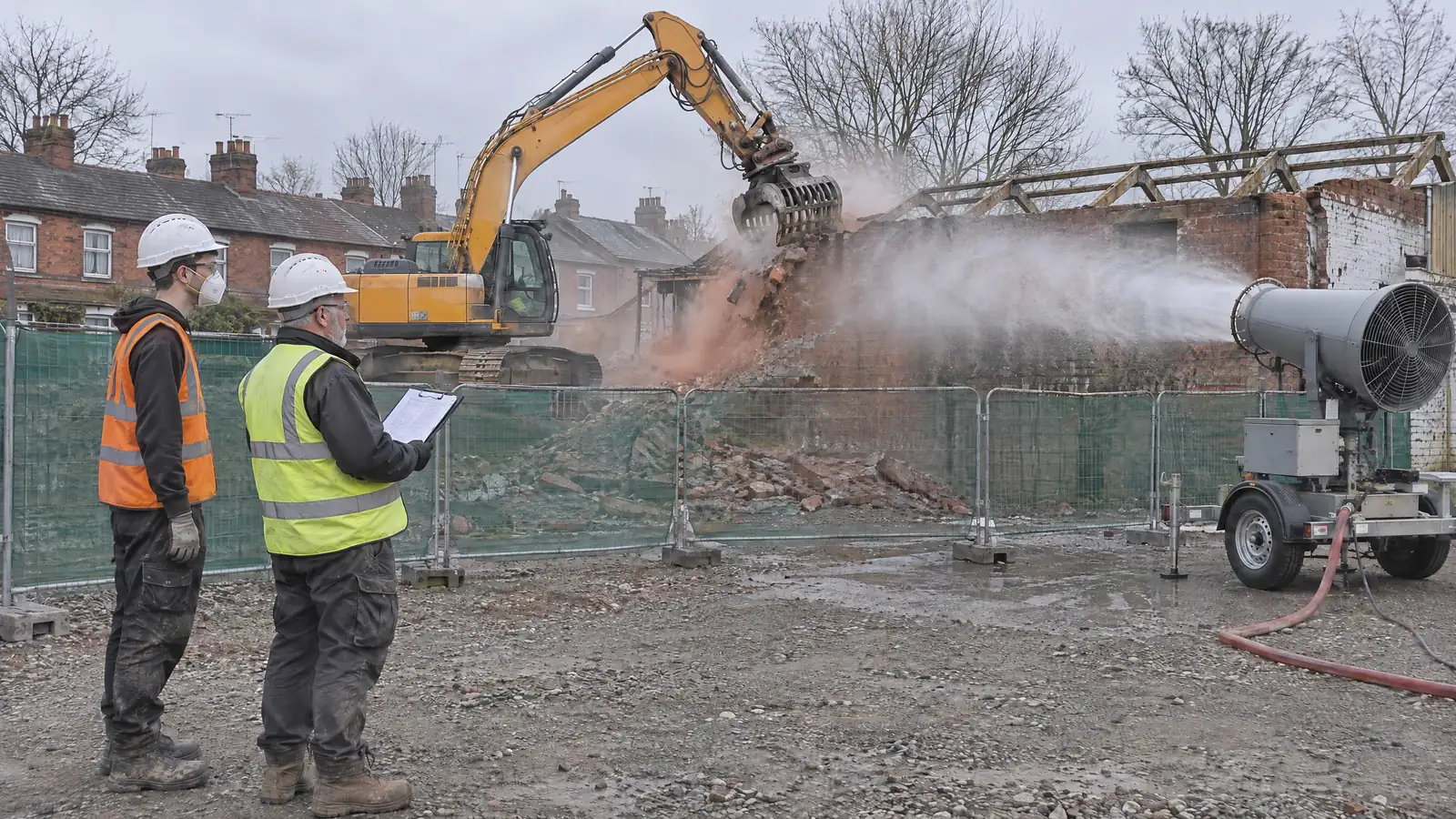
A demolition RAMS records something most RAMS do not have to: arrangements the law says must be written down. CDM 2015 regulation 20 says the arrangements for demolition or dismantling "must be recorded in writing before the demolition or dismantling work begins", and HSE says this is usually done with a method statement generated from a risk assessment. On top of a general RAMS, it shows the asbestos survey and what was removed, how services are disconnected, the sequence that keeps the structure stable until it comes down, the exclusion zones, and how dust, noise and debris are controlled.
This page is for builders and small contractors in Great Britain who are asked for a demolition RAMS before strip-out or demolition work: taking down a garage, outbuilding or extension, removing internal walls or chimney breasts, or stripping out a shop or office before a fit-out. Large or complex structures need a specialist demolition contractor, and HSE's demolition guidance recommends advice from a competent demolition engineer, especially on complex jobs. Northern Ireland has its own regulations, so check those if you work there.
If you need a blank document to fill in, use the free RAMS template. For the sections every method statement needs, see our guide on how to write a method statement.
Why demolition is different: the plan must be in writing
For most construction work, a method statement is something a client or main contractor asks for, not something the law names. HSE's own page puts it this way: "While not required by law, method statements are also prepared for many other construction activities". Demolition is the exception. Regulation 20 of the Construction (Design and Management) Regulations 2015 says:
- the demolition or dismantling of a structure "must be planned and carried out in such a manner as to prevent danger or, where it is not practicable to prevent it, to reduce danger to as low a level as is reasonably practicable"
- the arrangements "must be recorded in writing before the demolition or dismantling work begins"
HSE's summary of the paperwork goes further and puts structural alteration in the same group: the arrangements for demolition, dismantling or structural alteration "must be recorded in writing", and "This is usually achieved by means of a method statement that can be generated from a risk assessment." So if the job includes structural alteration, such as taking out a load-bearing wall, treat its arrangements the same way.
The risk assessment duty still applies. Regulation 3 of the Management of Health and Safety at Work Regulations 1999 requires a suitable and sufficient risk assessment, and the significant findings must be recorded if you employ five or more people.
CDM applies to work on people's homes as well. Where the client is a homeowner, regulation 7 passes the client duties to the contractor where there is only one, or to the principal contractor where there is more than one. HSE's demolition guidance also says the method should be written by a competent person, take in all the hazards and risks, and be explained to the people doing the work.
What a demolition RAMS adds to a general one
A general RAMS covers access, manual handling, welfare and the rest of the job. For demolition, these parts need adding, in the risk assessment, the method statement or both:
| Part | In the risk assessment | In the method statement |
|---|---|---|
| Asbestos | What the survey found, where, and what was removed | Removal before demolition starts, and the rule for stopping if anything suspect turns up |
| Services | Live electricity, gas and water, and anything buried | Who disconnects each supply, and how you confirm it before work starts |
| Structural stability | Parts that could fall early: load-bearing walls, lintels, roofs, anything attached to a neighbour | The sequence, and any temporary support designed by a competent person |
| Exclusion and debris zones | Who could be hit: the crew, the client, neighbours, the public | Where the zones are, how they are marked, and who keeps them clear |
| Falls | Edges and openings made as the structure comes down | How work at height is avoided, or controlled where it cannot be |
| Dust, noise and vibration | Silica and other dust, and breaker noise and vibration | Water, extraction, respiratory protection, tool choice and time limits |
| Plant and debris | Machine movements, loading, skips and lorries | Who operates, who guides vehicles, and where debris goes |
| Notices | Notices the council and neighbours need | Who gives them and when |
Asbestos comes first
Asbestos is the first thing to settle, because nothing else on the job is safe until you know where it is. Regulation 5 of the Control of Asbestos Regulations 2012 says an employer "must not undertake work in demolition, maintenance or any other work which exposes or is liable to expose employees of that employer to asbestos" unless they have assessed whether asbestos is present, what type, in what material and in what condition. Where there is doubt, they must assume it is present and follow the regulations.
HSE's advice on older buildings says: "If the building was built or refurbished before 2000, assume that there is asbestos in it."
Before demolition, the survey you need is a refurbishment and demolition survey, which looks for asbestos-containing materials (ACMs). HSE says it "must locate and identify ACMs, including those hidden within the building fabric, before any structural work begins". It is intrusive, the area must be vacated while it is done, and it "must be carried out by a competent surveyor". A management survey, which is made for the everyday use of a building, is a different survey, so ask for the refurbishment and demolition one by name.
If asbestos is found, HSE says there is "a legal requirement for all ACMs to be removed, as far as reasonably practicable" before major refurbishment or demolition. HSE's advice for workers says "Higher-risk work with asbestos must be carried out by a contractor licensed by the Health and Safety Executive (HSE)", and "If in doubt, assume the work is licensed and stop work until you are told otherwise."
In the RAMS, record:
- the survey's date and who carried it out
- what it found, where, and what has been removed, and by whom
- that demolition does not start until removal is confirmed
- a stop rule: anyone who finds suspect material stops work, keeps others away and tells the supervisor
Services: disconnected and confirmed before you start
Live services are one of the things HSE expects to be known before demolition starts. Its demolition guidance says the client, with the principal designer, must provide information before work begins about asbestos, the structural stability of the site and nearby structures, alterations to the structure, and below-ground live services. On a domestic job where you hold the client duties, gathering this falls to you.
Your RAMS should list every supply to the structure (electricity, gas, water, and any telecoms or drainage) and, for each one, who disconnects or diverts it and how you confirm it is off before work starts. Disconnections are arranged through the supplier, the network operator or a suitably qualified engineer. If you will break out floor slabs or foundations, add how you will check for buried cables and pipes before digging or breaking.
Keeping the structure stable until it comes down
Regulation 19 of CDM 2015 says "All practicable steps must be taken, where necessary to prevent danger to any person" to stop a structure collapsing when construction work may make it unstable or leave it temporarily weak. It also says "A structure must not be so loaded as to render it unsafe to any person", which matters when debris is piled on a floor or against a wall.
HSE's guidance on structural stability during alteration, demolition and dismantling says:
- "A competent person should do a full survey and assessment of the structure", taking in its age, previous use, type of construction and anything nearby
- "A suitably qualified and experienced engineer should decide if temporary support is necessary"
- temporary supports must be designed, installed and maintained to withstand foreseeable loads
- the arrangements should include "the sequence required to prevent accidental collapse of the structure"
HSE's demolition guidance adds that work should proceed so that an uncontrolled collapse is ruled out, usually removing the parts that are not critical to stability first, and that scaffolding must not be used to support a structure unless it was designed for that.
In the method statement, write the sequence as numbered steps in the order the structure comes down. Say what each part is holding up before you remove it, where any props or temporary works go and who designed them, and what is left standing at the end of each day and why it is stable.
Exclusion zones, falls and the public
HSE's demolition guidance says the plan should show safe working, exclusion and debris zones. Their size depends on the technique, the space around the structure and how far debris could fall, and they may need to change as the work goes on. The aim is that, even if something collapses, the debris stays inside the zone and nothing crosses the site boundary.
In the RAMS, mark each zone on a sketch or describe it in metres, say how it is fenced or marked, and name who keeps it clear. Add what happens when someone walks in: the machine stops, or the work stops, until they are out.
Demolition makes new edges and openings: a floor with no wall around it, a gap where a stair was, the top of a part-demolished wall. HSE's guidance is to reduce work at height where possible, for example by using a high-reach machine with a protected cab instead of people on the structure. Where someone does have to work at height, our guide to working at height RAMS covers ladders, towers and MEWPs.
The guidance also says duty holders must protect members of the public and neighbouring businesses, and limit the dust and debris that escape. On a house or high street job, that means the neighbours, passers-by and the client's own household.
Dust, noise and vibration
Breaking brick, block and concrete releases silica dust, and stripping out plaster, boards and ceilings adds more. HSE's guidance on soft strip demolition says "Soft strip demolition can produce high levels of dust" and that the dust can cause "serious lung diseases like cancer, silicosis and COPD". It sets out these controls:
- plan the work, limit the number of people in the work area, and screen off areas to stop dust spreading
- "use water suppression or on-tool extraction for those tasks where it is possible"
- wear respiratory protection "with an assigned protection factor of 20 (eg FFP3 disposable mask or half mask with a P3 filter)"
- for work over an hour without a break, consider powered respiratory protection with the same protection factor
- fit test tight-fitting masks; wearers need to be clean-shaven
- get natural ventilation into the work area, for example by opening windows
The details of dust controls belong in your COSHH assessment, and the RAMS should point to it. For noise and vibration, say which tools you will use and how you will keep exposure down: a breaker on a machine instead of a hand-held one where practicable, rotating the people using hand tools, and hearing protection. HSE's guidance on noise and vibration covers the exposure limits.
Notices, neighbours and the council's method statement
In England and Wales, section 80 of the Building Act 1984 requires notice to the local authority before demolishing the whole or part of a building. HSE's demolition guidance says the notice must be given at least 6 weeks before demolition starts. The section lists exceptions, including:
- an internal part of an occupied building that is intended to remain occupied
- a building with a cubic content of not more than 1750 cubic feet (about 50 cubic metres), measured externally
- a greenhouse, conservatory, shed or prefabricated garage that forms part of a larger building
- an agricultural building, unless it is joined to a building that is not agricultural
Copies of the notice go to the occupiers of adjacent buildings and to the gas and electricity suppliers. The council may reply with a notice setting conditions for the work. Scotland has its own rules, so check with the local authority there.
Some councils also ask for a demolition method statement as part of a planning application, covering things such as the reasons for demolition, the sequence, access, working hours and hazards. That document is written for the council and the neighbours. The RAMS is written for the people doing the work. Both describe the same job, so make sure they agree.
Worked example (fictional): taking down a detached double garage
This example is made up to show the level of detail to aim for. It is not a template to copy, and every job needs its own.
The job: a small building firm takes down a detached brick double garage, about 6 by 6 metres, at the end of a back garden, to clear the way for an extension. The garage was built in the 1970s and had a cement sheet roof. The homeowner is the client and the firm is the only contractor, so the firm carries the client duties under CDM. A neighbour's timber fence runs a metre from one wall. The garage had lights and a socket fed from the house, and no gas or water. The crew is a supervisor, a labourer and an excavator operator with a compact tracked machine.
Before the job: a refurbishment and demolition survey by a competent surveyor found asbestos cement roof sheets. A specialist contractor removed them and confirmed this in writing. The firm gave the council a demolition notice, because the garage is too big for the small building exception, and sent copies to the neighbours and the suppliers. An electrician disconnected the garage supply at the house end and confirmed it in writing.
| Hazard | Who could be harmed | Controls |
|---|---|---|
| Asbestos the survey did not find | The crew, the household, neighbours | Refurbishment and demolition survey; roof sheets removed first; stop rule for any suspect material |
| Walls falling the wrong way | The crew, neighbours | Walls taken down from the top in small sections; material dropped inwards onto the slab, away from the fence |
| Struck by falling masonry or the machine | The crew, the household | Fenced exclusion zone; household keeps out of the garden during demolition; machine stops if anyone enters |
| Live cable | The crew | Supply disconnected at the house end by an electrician and confirmed in writing before work starts |
| Silica dust | The crew, the household, neighbours | Water spray on the brickwork and the slab; FFP3 masks, face fit tested; work paused if dust blows towards the houses |
| Noise and vibration from breaking the slab | The crew, neighbours | Machine-mounted breaker, not hand-held; hearing protection; working hours agreed with the neighbours |
| Vehicle movements when loading | The crew, the public | Skip on the drive, not the road; machine stopped while the skip lorry is in; labourer guides the lorry |
Method steps (fictional example):
- Check that the survey report, the asbestos removal confirmation, the electrician's confirmation and the council notice are in the site file, that the notice period has passed, and that any conditions from the council are written into this RAMS.
- Brief the crew on this RAMS and have each person sign it.
- Fence the exclusion zone around the garage, sized to cover where walls and debris could fall, and agree with the household that the garden stays out of use until the fence comes down. On the fence side, agree with the neighbour that they keep clear of their side of the fence while that wall comes down.
- The supervisor walks the empty garage to confirm the roof sheets have gone and nothing else looks suspect. If anything does, stop and get it checked.
- Remove glass, doors and timber by hand from ground level, glass first.
- Set up the water spray, operated from outside the exclusion zone.
- The operator takes the walls down from the top in small sections, dropping material inwards onto the slab and away from the neighbour's fence. The fence-side wall comes down last. Nobody enters the zone while the machine works.
- Damp down the rubble and load it into the skip with the machine.
- When the skip lorry arrives or collects, the machine stops and the labourer guides the lorry on the drive.
- Break out the slab with the machine-mounted breaker, with the water spray kept on.
- Check the area, take down the fence and record that the job is complete.
Demolition checks before you send it
- Are the arrangements written down, and dated before any demolition starts?
- Does it name the asbestos survey, what it found and what was removed, by whom?
- Does it have a stop rule for suspect material?
- Does it list every service, and who confirmed each one is off?
- Does it set out the sequence, and who decided on any temporary support?
- Does it mark the exclusion zones, and name who keeps them clear?
- Does it set dust controls: water or extraction first, then masks with a protection factor of at least 20, face fit tested?
- In England and Wales, does it cover the council notice, or why none is needed?
Where AI RAMS fits, and what it does not do
AI RAMS is our own product, so its limits come first:
- It does not carry out asbestos surveys, structural assessments, temporary works designs or demolition notices. It makes three documents: risk assessments, method statements and COSHH assessments, each in its own chat.
- It has no demolition template. The chat asks about your trade, the tools and the job.
- It does not check that your risk assessment and method statement agree, so compare them before sending.
For a job like the one above, it drafts the risk assessment and method statement from your description and answers, and it can draft the COSHH assessment for the dust in a separate chat. The method statement chat can pick up the details from a risk assessment you made for the same job in the last week. The draft knows only what you tell it about the site: you add the survey results, the sequence, the zones and the names, then check, edit and sign it. Our guide to creating a method statement in AI RAMS shows the chat. To try it, start a draft, or see current prices first.
Frequently asked questions
Is a method statement a legal requirement for demolition?
The written arrangements are. CDM 2015 regulation 20 says the arrangements for demolition or dismantling must be recorded in writing before the work begins, and HSE says this is usually done with a method statement generated from a risk assessment. The law does not set a format, so what matters is that the arrangements are written down.
Does CDM 2015 apply to demolition on a house?
Yes. Demolition is construction work under CDM 2015, including on domestic projects. Where the client is a homeowner, the client duties pass to the contractor, or to the principal contractor where there is more than one contractor.
Do I need an asbestos survey before demolition?
You need to know whether asbestos is present before you start, and HSE says the right survey before demolition is a refurbishment and demolition survey by a competent surveyor, done before any structural work begins. HSE also says to assume there is asbestos in any building built or refurbished before 2000.
Do I need to tell the council before demolishing a building?
In England and Wales, usually yes. Section 80 of the Building Act 1984 requires notice to the local authority before demolishing the whole or part of a building, and HSE says to give it at least 6 weeks before work starts. There are exceptions, including internal demolition in a building that stays occupied and buildings of 1750 cubic feet (about 50 cubic metres) or less. Scotland and Northern Ireland have their own rules.
What mask do I need for demolition dust?
HSE's guidance for soft strip demolition says to use water or on-tool extraction where possible, then respiratory protection with an assigned protection factor of 20, such as an FFP3 disposable mask or a half mask with a P3 filter. Tight-fitting masks need face fit testing and a clean-shaven wearer.
Who should write a demolition method statement?
A competent person. HSE's demolition guidance says the method should be written by a competent person who considers all the hazards and risks, and it recommends advice from a competent demolition engineer on complex jobs. HSE also says a suitably qualified and experienced engineer should decide whether temporary support is needed.
By Filip Perkon, Director, AI RAMS. Legal points last checked on 11 November 2026 against HSE guidance and legislation.gov.uk. This is general information, not legal advice.
Ready to try AI-powered RAMS?
Create, preview and edit documents free, with no card needed. Pay only when you download.
Start free