
Working at Height RAMS: Ladders, Mobile Towers and MEWPs
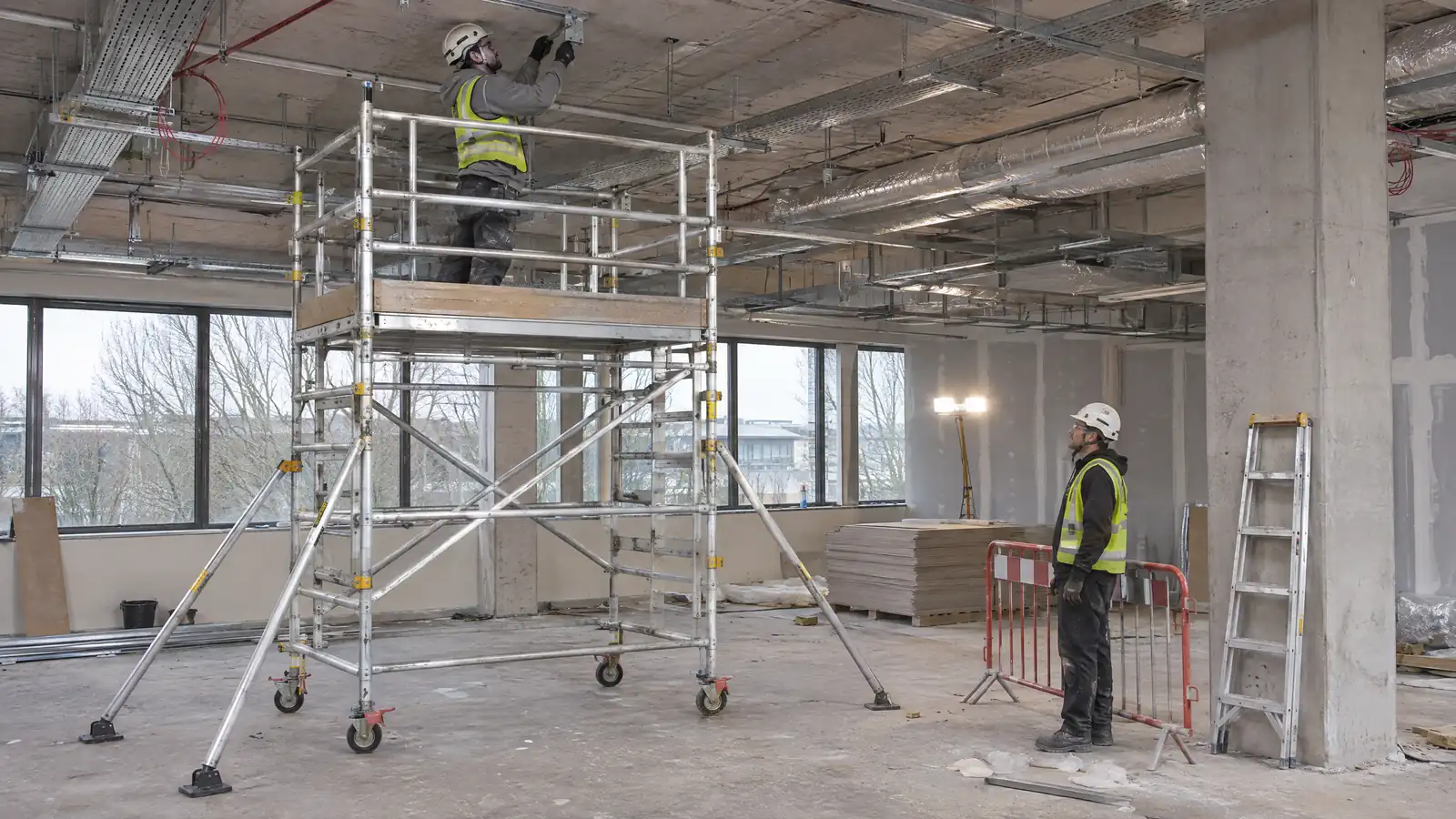
A working at height RAMS shows why the work has to be done at height at all, which equipment you chose and why, who puts it up and checks it, how people and objects are stopped from falling, and how someone would be rescued if they were hurt, taken ill or stuck at height. The Work at Height Regulations 2005 require work at height to be properly planned, and that planning includes emergencies and rescue. There is no minimum height. The law also asks for a suitable and sufficient risk assessment, recorded if you employ five or more people. HSE says method statements are not required by law for most construction work, but a main contractor or client can make RAMS a condition of starting.
This page is for trades in Great Britain who are asked for RAMS before work on stepladders, leaning ladders, mobile towers or mobile elevating work platforms (MEWPs): decorators, electricians, ceiling fixers, shopfitters, sign installers and maintenance teams. Northern Ireland has its own Work at Height Regulations (Northern Ireland) 2005, so check those if you work there. Roof work, rope access and scaffold design need more than this page covers.
If the job is small and nobody has asked for paperwork, start with our 30-second check for small jobs. If you need a blank document to fill in, use the free RAMS template.
What the law asks before you choose any equipment
HSE defines work at height as "work in any place where, if there were no precautions in place, a person could fall a distance liable to cause personal injury". A stepladder in an office counts as much as a scaffold. HSE also says falls from height are one of the biggest causes of workplace deaths and major injuries, and that common causes are falls from ladders and through fragile roofs.
Regulation 6 sets an order you have to work through, and your RAMS should show that you did:
| Step | What regulation 6 says | What to write in the RAMS |
|---|---|---|
| 1. Avoid | Do not work at height where it is reasonably practicable to do the work safely otherwise | One line on why the job cannot be done from the ground, for example with extension poles or by assembling parts at floor level first |
| 2. Prevent | Where you must work at height, take suitable and sufficient measures to prevent a fall, using an existing safe place of work or the right equipment | The equipment you chose, and why it prevents a fall rather than only reducing one |
| 3. Minimise | Where a fall is still possible, use equipment that reduces the distance or the consequences, plus training and instruction | Any fall arrest, nets or soft landing systems, and the training the user has |
Regulation 7 adds that when you choose equipment you must give "collective protection measures priority over personal protection measures". So guardrails that protect everyone come before a harness that protects one person. Regulation 7 also lists what to weigh up: the working conditions, the distance and consequences of a fall, how long and how often the equipment is used, and "the need for easy and timely evacuation and rescue in an emergency".
Regulation 4 asks for the work to be properly planned, appropriately supervised and carried out as safely as is reasonably practicable. It says planning "includes planning for emergencies and rescue", and that work at height goes ahead only when the weather does not put anyone at risk. Regulation 5 asks that anyone doing the work, or supervising it, is competent, or is being trained under the supervision of someone who is.
What a working at height RAMS should say about the equipment
The RAMS should say why the equipment suits the task and how it is checked. The table below sets out what each common choice needs on the page.
| Equipment | When it suits | What to add to the RAMS |
|---|---|---|
| Stepladder or leaning ladder | Low risk, short duration tasks, or where existing features of the site cannot be altered | Why a ladder is justified, the pre-use check, three points of contact, how it is secured, and who checks it |
| Mobile tower | Longer tasks at one height, or tasks needing tools and materials on a platform | Who builds it and their training, the manufacturer's instructions, the inspection after assembly, castors locked and outriggers fitted |
| MEWP (scissor or boom lift) | Higher work, work over obstructions, or work that moves along a line | Operator training and familiarisation on that machine, ground conditions, overhead hazards, trapping risk, and the rescue plan |
Ladders and stepladders
Ladders are not banned. HSE's work at height FAQs say ladders can be used when a risk assessment has shown that equipment with a higher level of fall protection is not justified because the risk is low and the use is short, or because existing features on site cannot be altered. HSE adds that short duration is not the deciding factor on its own, and that if a task would keep someone on a leaning ladder or stepladder for more than 30 minutes at a time, you should consider other equipment.
HSE's ladder leaflet, Safe use of ladders and stepladders (INDG455), gives the points that belong in your method steps:
- A pre-use check by the user before each task, looking for obvious visual defects, with defects reported.
- Three points of contact when climbing: a hand and two feet.
- A leaning ladder set at 75 degrees, the 1 in 4 rule: one unit out for every four units up.
- A leaning ladder tied to a suitable point at both stiles where possible, with a stability device, wedging or footing as the fallbacks.
- A stepladder facing the work, not side on, unless the risk assessment shows side on is safer.
- No overreaching: your belt buckle stays within the stiles.
Mobile towers
HSE's FAQs say that once a tower is built it must be inspected by a competent person before it is first used, and again every time something happens that may affect its stability or safety. For construction work, regulation 12 adds a rule for any working platform from which a person could fall 2 metres or more. A mobile platform, such as a tower, must have been inspected on the site within the previous 7 days, so on a longer job the inspection is repeated at least weekly, as well as after anything that affects its stability. The person who inspects it writes a report before the end of that working period and gives it, within 24 hours, to the person the inspection was done for, such as your employer or the main contractor.
In the RAMS, name who builds the tower and the training they hold, say that it is built and moved to the manufacturer's instructions, and give where the inspection record is kept. Write the guardrails and toe boards on the platform as your collective protection.
MEWPs
HSE's safety alert on trapping in MEWPs describes operators who "have become trapped between the guardrails or other equipment on the platform and adjacent obstructions". It points to effective work planning, choosing a machine for the specific task and environment, training on the specific machine, and "detailed procedures to be followed if someone is trapped and needs to be rescued quickly". HSE's FAQs add that climbing out of the basket is not normally recommended.
A MEWP that lifts people is also lifting equipment, so ask the hire company for its current thorough examination report. In the RAMS, record the operator's training, who has checked the ground and what is overhead, any harness and anchor point that the manufacturer or site rules call for, and who on the ground can bring the platform down.
Rescue and emergencies: plan them before anyone goes up
Because regulation 4 makes rescue part of planning, a line that says "call 999" is not enough on its own. Write the rescue as steps your own team can carry out while help is on its way.
- Ladders and stepladders: first aid, who calls for help, and how the person is reached without moving them if they may be injured.
- Mobile towers: how an injured or unwell person on the platform is reached and brought down, and who on site is trained to do it.
- MEWPs: a named person on the ground trained to use the ground controls and lower the platform, and a trapping procedure that has been practised, as HSE's alert asks.
- Harnesses: if anyone could be left hanging after a fall, how they will be reached quickly.
Add the site's emergency arrangements too: the first aid point, the assembly point and how the alarm is raised.
Falling objects and the people below
Regulation 10 requires steps to prevent anything falling where it could injure someone, and regulation 11 requires danger areas to be marked and kept clear of people who should not be there. In an occupied building, the people below may be office staff, shoppers or pupils rather than other trades.
Write down the toe boards on platforms, tool lanyards where tools are used over people, how materials go up and come down, and the barriers and signs around the base. Say who keeps the area clear while the work is going on.
Fragile surfaces, edges and openings
Regulation 9 covers fragile surfaces such as roof lights, old asbestos cement sheets and some ceiling tiles. If the job takes anyone onto a roof or above a suspended ceiling, the RAMS needs its own section on it, covering how the fragile parts are identified, covered or guarded, and how people are kept off them. Treat roof work as a separate job: it is outside what this page covers.
Indoors, look for open stairwells, lift shafts, risers and mezzanine edges near where you will be working, and say how they are guarded.
Worked example (fictional): ceiling brackets on an office fit-out
This example is made up to show the level of detail main contractors commonly ask for. It is not a template to copy, and every job needs its own.
The job: a two-person team fixes 40 ceiling brackets for new lighting in an open-plan office on the second floor of a building that is being fitted out. The ceiling is 3.4 metres high. The floor is level concrete. Other trades are working on the same floor, and the main contractor runs the site.
Why at height, and why a tower: the brackets have to be fixed to the soffit, so the work cannot be done from the floor. Each bracket takes about 15 minutes and the team will be working overhead for most of two days, so a ladder is not justified. A mobile tower with guardrails gives collective protection and room for tools.
| Hazard | Who could be harmed | Controls |
|---|---|---|
| Fall from the tower platform | The two fixers | Tower built by a trained person to the manufacturer's instructions; guardrails and toe boards on the platform; inspected after assembly and after each move; nobody climbs the outside |
| Tower overturning | The fixers and anyone nearby | Castors locked and outriggers fitted at every position; floor checked for openings and level changes before each move; moved only as the manufacturer's instructions allow |
| Falling tools or brackets | Other trades on the floor | Toe boards; tools on lanyards; barrier and signs round the base; second fixer keeps the area clear |
| Drilling dust | The fixers | Drill with dust extraction; masks as set out in the COSHH assessment |
| Injury or illness at height | The fixers | Rescue steps agreed and briefed; first aider on site; second fixer stays at the base |
Method steps (fictional example):
- Sign in, attend the site induction and read the site's rules on towers and permits.
- Check the ceiling area for services and confirm the fixing positions with the main contractor.
- Set out barriers and signs around the first position.
- The trained fixer builds the tower to the manufacturer's instructions, with guardrails, toe boards, outriggers and locked castors.
- The trained fixer, who is the competent person for this tower, inspects it before first use and records it in the main contractor's inspection register.
- Climb only on the inside, using the built-in ladder, with tools raised in a bag.
- Fix the brackets within reach of the platform, without leaning over the guardrails.
- Before each move, clear the platform, step down and check the route for openings and level changes.
- After each move, lock the castors and refit the outriggers, and the trained fixer inspects the tower again and records it before anyone climbs.
- At the end of each day, clear the platform, leave the tower where the main contractor agrees, and fit a sign to stop anyone else using it.
- If someone is injured or unwell at height, the second fixer calls the site first aider and the supervisor, and calls 999 if needed, sending someone to meet the ambulance. The first aider assesses the person on the platform before anyone tries to bring them down.
- At the end of the job, dismantle the tower in reverse order, remove the barriers and hand the area back.
Working at height checks before you send it
- Does the RAMS say why the work cannot be done from the ground?
- Does it say why you chose that equipment, and why a ladder is or is not justified?
- Are collective measures, such as guardrails, listed before personal ones, such as a harness?
- Does it name who builds, inspects and uses the equipment, and their training?
- Does it say when the equipment is inspected and where the record is kept?
- Is there a rescue plan your own team can carry out?
- Does it protect the people below, with barriers, toe boards and a clear area?
- Does it cover the weather, if any of the work is outdoors?
Where AI RAMS fits, and what it does not do
AI RAMS is our own product, so its limits come first:
- It does not make permits to work, rescue plans as separate documents, toolbox talks or inspection reports. It makes three documents: risk assessments, method statements and COSHH assessments, each in its own chat.
- There are no working at height templates. The chat asks about your trade, the equipment and the job.
- It does not check that your risk assessment and method statement agree, so compare them before sending.
For a job like the one above, it drafts the risk assessment and method statement from your description and answers. The method statement chat can pick up the details from a risk assessment you made for the same job in the last week. The draft knows only what you tell it about the site: you add the equipment, the names, the inspection arrangements and the rescue steps, then check, edit and sign it. Our guide to creating a method statement in AI RAMS shows the chat, and our guide on how to write a method statement covers the sections every one needs. To try it, start a draft, or see current prices first.
Frequently asked questions
Is there a minimum height for the work at height rules?
No. HSE defines work at height as work in any place where, if there were no precautions in place, a person could fall a distance liable to cause personal injury. That includes work on a stepladder. Some rules in the regulations, such as the inspection of construction working platforms, apply from 2 metres.
Can I still use a ladder?
Yes, if your risk assessment shows that equipment with more fall protection is not justified because the risk is low and the use is short, or because features of the site cannot be altered. HSE says short duration is not the deciding factor on its own, and suggests considering other equipment for tasks over 30 minutes at a time.
How often does a mobile tower need inspecting?
HSE says a competent person inspects it once it is built, before first use, and again after anything that may affect its stability or safety. On construction work, where someone could fall 2 metres or more, it must also have been inspected on the site within the previous 7 days, with a written report.
Do I need a rescue plan for a MEWP?
Yes. The Work at Height Regulations 2005 say planning includes emergencies and rescue. HSE's alert on trapping in MEWPs calls for detailed procedures to follow if someone is trapped and needs rescuing quickly. Name who on the ground can use the ground controls.
Do I need a harness on a mobile tower?
Not usually. The regulations put collective protection, such as a tower's guardrails, before personal protection, such as a harness. Follow the manufacturer's instructions and the site's rules, and write any harness use, with its anchor point, into the RAMS.
Is a RAMS a legal requirement for work at height?
Not by that name. The law requires a suitable and sufficient risk assessment, recorded if you employ five or more people, and requires work at height to be properly planned. HSE says method statements are not required by law for most construction work, but main contractors and clients can require RAMS before you start.
By Filip Perkon, Director, AI RAMS. Legal points last checked on 10 November 2026 against HSE guidance and legislation.gov.uk. This is general information, not legal advice.
Ready to try AI-powered RAMS?
Create, preview and edit documents free, with no card needed. Pay only when you download.
Start free