
Hot Works RAMS: What to Include for Permits and Fire Watch
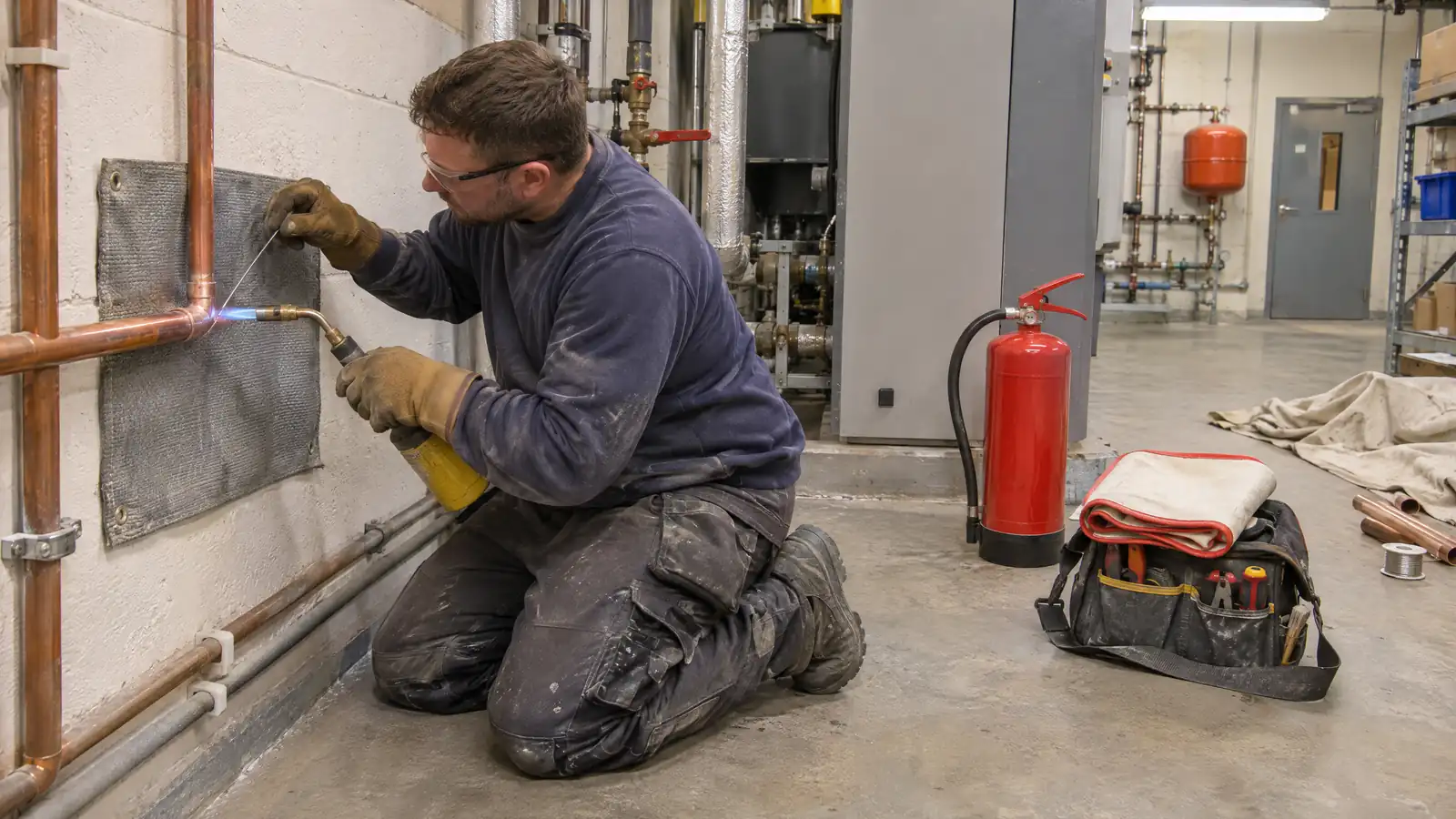
A hot works RAMS shows why heat is needed at all, how combustible materials are cleared or protected, the permit the site issues, the extinguishers within reach, the fire watch during and after the work, and how gas cylinders are stored and taken away. HSE's guidance, Fire safety in construction (HSG168), says hot works should be designed out where practicable, and calls for a formal permit-to-work system where they cannot be avoided. The law asks for a suitable and sufficient risk assessment, recorded if you employ five or more people. HSE says method statements are not required by law for most construction work, but a main contractor, client or building owner can make RAMS a condition of starting.
This page is for trades in Great Britain who are asked for RAMS before work that uses a flame or makes sparks or heat: plumbers and heating engineers soldering or brazing, roofers using a torch, welders and fabricators, and anyone cutting or grinding metal on site. It follows the third edition of HSG168, published in 2022. Northern Ireland has its own regulations, so check those if you work there.
If the job is small and nobody has asked for paperwork, start with our 30-second check for small jobs. If you need a blank document to fill in, use the free RAMS template.
What counts as hot work
HSG168 defines hot work as "any process that generates flame, sparks or heat". That covers more than welding:
- soldering and brazing copper pipework with a gas torch
- torch-on roofing and other work with an open flame
- welding and flame cutting
- cutting and grinding metal with tools that throw sparks
- using hot air guns and other tools that heat surfaces
The law behind it is mostly general. The Construction (Design and Management) Regulations 2015, regulation 29, require suitable and sufficient steps to prevent, so far as is reasonably practicable, injury from fire or explosion during construction work. Regulation 32 adds that nobody may carry out work that gives rise to "a particular risk of fire" unless suitably instructed, and that people on site are instructed in the correct use of fire-fighting equipment. HSG168 sets out how HSE expects those duties to be met for hot work.
Can the job be done without heat?
HSG168 says "Hot works should be designed out where practicable and substituted with cold methods." It prefers cold cutting where reasonably practicable. Where hot work cannot be avoided, it suggests lower-risk tools, "such as electrically powered torches or heat guns".
In practice, that can mean mechanical or press-fit pipe fittings instead of soldered joints, cold-applied roofing systems instead of a torch, or a saw instead of a grinder, where the specification and the client allow. Your RAMS should carry one line on why heat is still needed.
What a hot works RAMS adds to a general one
A general RAMS covers access, manual handling, dust and the rest of the job. For hot work, these parts need adding, in the risk assessment, the method statement or both:
| Part | In the risk assessment | In the method statement |
|---|---|---|
| Why heat is needed | The cold methods considered, and why they will not work | The tool and fuel you will use |
| The permit | The site's permit rule, as a control | When the permit is requested, who issues it and who closes it |
| Combustibles | What could catch fire, including on the other side of walls and below the work | How it is cleared or covered before work starts |
| Fire-fighting | Extinguishers and the fire alarm as controls | Where the extinguishers are and who is trained to use them |
| Fire watch | The watch as a control for fires that start after the work stops | Who watches, for how long and how it is signed off |
| Gas cylinders | Storage and handling of flammable gas | Where cylinders are kept, and when they come off the work area |
| Fumes | Fumes from welding, brazing, flux or roofing materials | Ventilation, extraction and respiratory protection from your COSHH assessment |
The permit: what it covers and who signs it
HSG168 says a formal permit-to-work system should be used where hot work cannot be avoided, and that permits "should not give blanket authorisations to carry out hot works anywhere on site at any time". It lists what a permit should normally cover:
- the location and nature of the work
- the proposed time and duration
- the limits of time for which the permit is valid
- the precautions before, during and after the work
- the alarm procedure
- the person in direct control of the work
- the person who authorises the work and the person who closes it
On most jobs the permit comes from the main contractor or the building's manager, not from you. Your RAMS should say that you will work to the site's permit, who you expect to issue it, and that no hot work starts until it is signed. Ask about the building's fire alarm too: if heat or smoke detectors near the work might be affected, the site decides what happens to them, and your RAMS should record who deals with them and who restores them when you finish. Your own insurer may also set conditions for hot work, so check your policy and write any of its conditions into the method steps.
Before you light up: clearing and protecting
HSG168 lists the precautions to take before and during hot work. Write each of these as a check in your method steps:
- Remove loose combustible material from the work area, from below it, and from the other side of any wall or partition you are working against.
- Check for openings in walls, floors and ceilings where heat or sparks could get through, and clear behind them.
- Protect anything that cannot be moved, and any openings, with non-combustible board.
- Make sure "at least two suitable fire extinguishers are provided within reach of the hot work activity".
- Where the site or the permit asks for them, use a combustible gas detector to check for flammable gas before lighting up, or a thermal imaging camera to look for hidden hot spots during the fire watch.
The fire watch: during the work and after it
Fires from hot work can start well after the torch is off. HSG168 says "There should be a continuous fire watch of the hot work area for at least an hour after the end of hot work", followed by at least one more check two hours after the end. The watch continues through breaks, and it covers any areas where the heat could have passed through walls, floors and ceilings. HSG168 also says "All hot works should be completed two hours before the end of the working day", so the watch is not cut short when the site closes.
| When | What happens | Who |
|---|---|---|
| Before starting | Permit issued, area cleared and protected, extinguishers in place | The person in control, and whoever issues the permit |
| During the work | Watch kept on the work area and any areas behind or below it, including during breaks | A named fire watcher |
| For at least an hour after | Continuous fire watch of the area | The named fire watcher |
| Two hours after | At least one further check of the area | The named fire watcher, or as the permit says |
| Close | Permit signed off and closed | The person named on the permit to close it |
Gas cylinders
Write down where cylinders are kept and how they move. HSG168 says cylinders should be stored as far as practicable from occupied buildings, construction activities and ignition sources, and that you should ask your supplier for advice on storing LPG. It also says to keep the number of cylinders on site to a minimum, to store oxygen apart from flammable gases such as LPG and acetylene, and to remove gas cylinders from the workplace and return them to the storage area once work is complete.
Worked example (fictional): new pipework in an occupied office plant room
This example is made up to show the level of detail main contractors and building managers commonly ask for. It is not a template to copy, and every job needs its own.
The job: a plumber and a mate replace a section of copper heating pipework in the basement plant room of an occupied office building. The building's facilities manager runs a hot work permit system. There is a timber stud wall next to part of the pipe run, and smoke detectors in the plant room. The plumber is the person in direct control of the work, and the mate is the named fire watcher.
Why heat: most joints will use press-fit fittings. Four joints next to existing soldered fittings have to be soldered to match, so a gas torch is needed for those only.
| Hazard | Who could be harmed | Controls |
|---|---|---|
| Fire from the flame or heated pipe | The plumbers, building occupants | Permit from the facilities manager; combustibles cleared; heat mat behind each joint; two extinguishers within reach; fire watch for at least an hour after, check at two hours |
| Fire spreading through the stud wall | Building occupants | Other side of the wall checked and cleared; joint next to the wall shielded with non-combustible board; watch includes the other side |
| Smoke detectors set off | Building occupants | Facilities manager decides how the detectors are managed under the permit and restores them at close |
| Gas cylinder leak or fire | The plumbers | One small cylinder in use; checked before use; taken out of the building at the end of each day |
| Burns | The plumbers | Gloves; pipe allowed to cool; hot joints marked until cool |
| Fumes from flux | The plumbers | Plant room ventilation running; as set out in the COSHH assessment |
Method steps (fictional example):
- Sign in with the facilities manager and agree the time for the soldered joints, finishing at least two hours before the end of the working day.
- Make all press-fit joints first.
- Clear combustibles from around the four joint positions, below them and on the other side of the stud wall.
- Fit a heat mat behind each joint, and non-combustible board where the joint is next to the wall.
- Place two extinguishers within reach and confirm both plumbers know how to use them.
- Request the hot work permit, and start only once it is signed and the detectors have been dealt with as the facilities manager decides.
- Solder the four joints, with the mate watching the work area and checking the other side of the wall after each joint.
- Turn off and remove the torch and cylinder from the work area.
- The mate, as the named fire watcher, keeps a continuous fire watch on the area, including the other side of the wall, for at least an hour after the last joint.
- Check the area again two hours after the last joint and record it.
- Ask the facilities manager to restore the detectors and close the permit.
- Remove the cylinder from the building and leave the area clean.
Hot works checks before you send it
- Does the RAMS say why heat is needed, and which cold methods were considered?
- Does it say that no hot work starts until the site's permit is signed?
- Does it name the person in control of the work and the fire watcher?
- Does it list the combustibles to clear, including below the work and behind walls?
- Does it place at least two suitable extinguishers within reach?
- Does it set a fire watch of at least an hour after the work, and a check at two hours?
- Does it finish hot work at least two hours before the end of the working day?
- Does it say where gas cylinders are kept, and that they leave the work area at the end?
Where AI RAMS fits, and what it does not do
AI RAMS is our own product, so its limits come first:
- It does not make hot work permits, fire watch records or toolbox talks. It makes three documents: risk assessments, method statements and COSHH assessments, each in its own chat.
- There are no hot works templates. The chat asks about your trade, the tools and the job.
- It does not check that your risk assessment and method statement agree, so compare them before sending.
For a job like the one above, it drafts the risk assessment and method statement from your description and answers, and it can draft the COSHH assessment for the flux or fumes in a separate chat. The method statement chat can pick up the details from a risk assessment you made for the same job in the last week. The draft knows only what you tell it about the site: you add the permit arrangements, the names and the fire watch times, then check, edit and sign it. If the job is also at height, such as work from a ladder, tower or MEWP, our guide to RAMS for working at height covers that part. Roof work needs its own planning beyond both guides. To try it, start a draft, or see current prices first.
Frequently asked questions
Is a hot work permit a legal requirement?
No law names a hot work permit for every job. HSE's guidance, HSG168, says a formal permit-to-work system should be used where hot work cannot be avoided, and a site or building manager can make a permit a condition of the work. Where the site has a permit system, follow it.
How long should a fire watch last after hot work?
HSG168 says there should be a continuous fire watch of the hot work area for at least an hour after the end of hot work, followed by at least one more check two hours after the end. It also says hot works should be completed two hours before the end of the working day.
Is grinding hot work?
Yes, by HSE's definition. HSG168 defines hot work as any process that generates flame, sparks or heat, and grinding metal throws sparks. Treat it like any other hot work: clear combustibles, have extinguishers within reach and keep a fire watch.
How many fire extinguishers do I need for hot work?
HSG168 says at least two suitable fire extinguishers should be provided within reach of the hot work activity. Choose types suited to what could catch fire, and make sure the people doing the work know how to use them.
Where should gas cylinders be kept overnight?
Not in the work area. HSG168 says to remove gas cylinders from the workplace and return them to the storage area once work is complete, to store them as far as practicable from occupied buildings, work and ignition sources, and to ask your supplier for advice on storing LPG.
Is a RAMS a legal requirement for hot works?
Not by that name. The law requires a suitable and sufficient risk assessment, recorded if you employ five or more people, and CDM 2015 requires steps to prevent injury from fire during construction work. HSE says method statements are not required by law for most construction work, but clients and main contractors can require RAMS.
By Filip Perkon, Director, AI RAMS. Legal points last checked on 10 November 2026 against HSE guidance and legislation.gov.uk. This is general information, not legal advice.
Ready to try AI-powered RAMS?
Create, preview and edit documents free, with no card needed. Pay only when you download.
Start free